
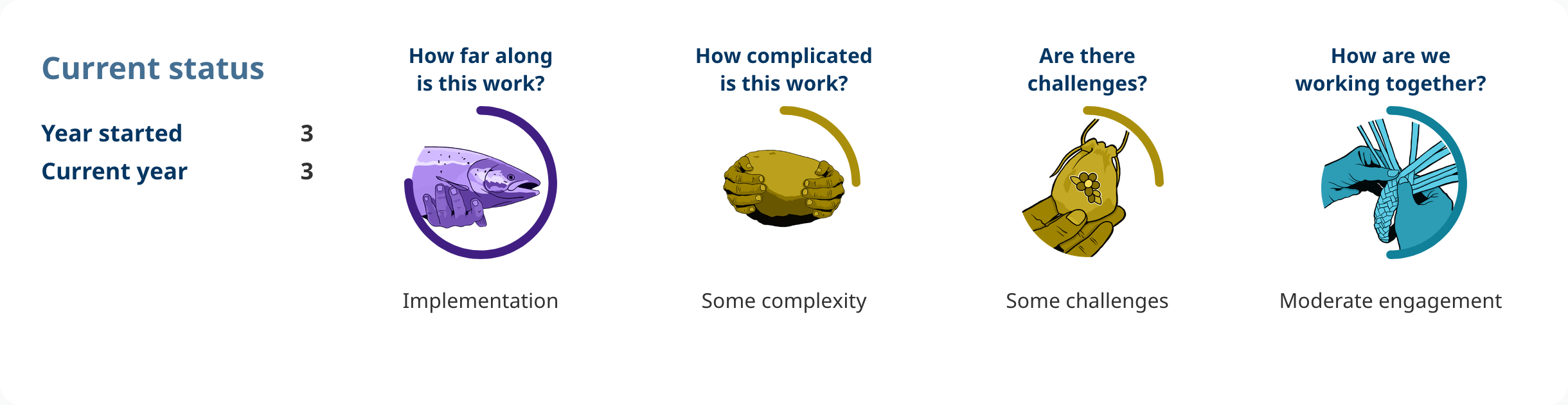
How are we working together?
The Ministry of Indigenous Relations and Reconciliation (MIRR) has worked with ministries across government to gather information on programs, funding and services available between 2018 to 2025 that are accessed by Indigenous Peoples living in urban areas. The review of nearly 95 programs has led to the identification of initial insights, core themes, gaps, challenges and areas for further collaboration.
Advancing Action 4.23 is limited to an internal review; however, the general findings of the work have been shared with partners who are involved in Action 4.21 and Action 4.22. While no formal discussions or engagements with external partners have taken place to date, initial themes have been shared with ministries with the greatest number of programs. As MIRR continues to analyze data/input and identify emerging insights, these findings will be shared with urban organizations involved in engagement through Action 4.21 and are expected to influence gatherings coordinated towards implementation of Action 4.22.The data analysis will support the development of a plan with clear timelines that will provide greater collaboration and coordination to meet needs of the urban sector and provincial government partners.
Are there challenges?
A main challenge relates to the number of programs across provincial government and the potential for a significantly expanded scope, which is why a phased approach to this work is underway with a review focused on Indigenous-specific programming. Capacity to develop complex plans is a challenge, however, in future years, consideration may be given to government programs that are widely accessible but used disproportionately by Indigenous people, such as social assistance or justice-based programs. MIRR has also observed that these programs may also benefit from an in-depth evaluation from an Indigenous perspective and/or by those with lived experience.
Highlights
The Province continues to focus on building strong relationships with partners. MIRR is updating the Guide to Indigenous Organization and Services a public-facing website that lists Indigenous-led organizations, agencies, governments and service providers. The updates make progress on action 4.23 and are directly responsive to ensuring the accuracy of public information. Providing accurate information on Indigenous organizations supports better coordination and information internally across provincial government and the public.
Previous years’ progress
Highlights
Initial work is underway to undertake a cross-government review of provincial supports and services for Indigenous Peoples in urban settings. Much of what is currently occurring involves collaboration between B.C. government ministries to evaluate what funding, programs and supports currently exists.
In doing this review, employees have recently learned of other information-gathering initiatives in government that may assist with how government shares information about available supports with Indigenous organizations. Although this work is in early stages, preliminary conversations have yielded excitement about what the findings of this review may reveal and the direction the work may take once partners are collaboratively working with government. This will lead to the development of a plan with clear timelines that will provide greater collaboration and coordination to meet the needs of urban Indigenous people. This may include a review of existing materials, committees, forums, as well as surveys and interviews and products and technology available with external providers.
Factors for consideration in this work include: working with Indigenous-led partner organizations where applicable, the scope of work, working within the context of a distinctions-based approach, programs and policies that support or are likely to have an impact on Indigenous people, as well as consideration for programming not specifically for Indigenous people, but with a disproportionate impact or uptake by Indigenous people.
How are we working together?
Initial work on Action 4.23 is taking place within the B.C. government, centered on reviews of programs, services and potential funding sources. Informal surveys about administrative processes such as contractual arrangement types, reporting requirements, and engagement themes have been conducted within the B.C. government. A database tool has been designed to assist in gathering information from ministries related to delivering programs, funding models and engagement themes. Throughout the process of this work, government anticipates working with partners such as urban Indigenous organizations to share findings, evaluate processes and work in partnership whenever possible.
The Provincial Urban Leaders Working Group is comprised of Urban Indigenous partners, the Ministries of Social Development and Poverty Reduction and Indigenous Relations and Reconciliation and was created to support implementation of Action 4.21. The Working Group’s workplan and actions reflect recommendations from early engagement with urban Indigenous organizations, including the importance of creating opportunities to ensure urban Indigenous voices are incorporated into the Province’s programs, policies and to co-develop a path forward through continued engagement.
While the Working Group is directly linked to Action 4.21, It’s through this relationship that discussions and engagement have occurred that has helped define the scope of the work, and potential focus areas of Action 4.23.
The findings of the data gathered to support Action 4.23 will lead to the development of a plan with clear timelines that will provide greater collaboration and coordination to meet needs. This may include a review of existing materials, committees, forums, as well as surveys and interviews and products and technology available with external providers. Factors for consideration in this work include: working with Indigenous-led partner organizations where applicable, the scope of work, working within the context of a distinctions-based approach, programs and policies that support or are likely to have an impact on Indigenous people, as well as consideration for programming not specifically for Indigenous people, but with a disproportionate impact or uptake by Indigenous people.
Are there challenges?
Capacity to resource this work and funding to continue to engage potential partners on the work are potential challenges that the Ministry of Indigenous Relations and Reconciliation is working to mitigate by exploring relationships with partner ministries doing similar projects.