
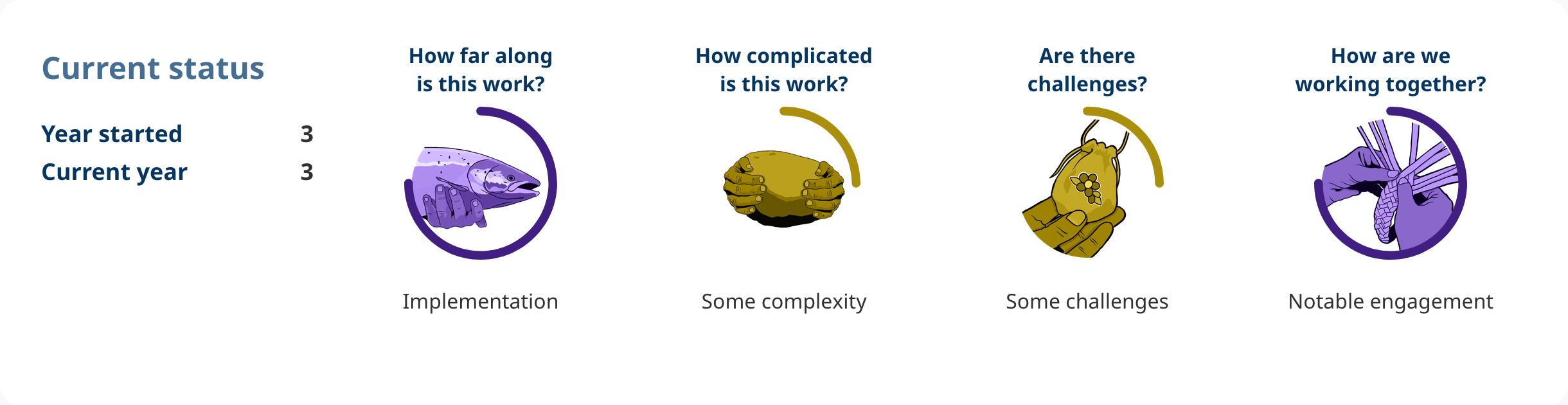
How are we working together?
The Province continues to engage with partners and urban Indigenous organizations to build an engagement model that enables communication and collaboration between the Province and urban Indigenous organizations that serve Indigenous Peoples. Action 4.21 and Action 4.22 are intrinsically linked, and should work together concurrently, rather than in a linear fashion with one following the other. Gathering in-person to discuss issues, priorities and opportunities is seen as a demonstration of implementing Action 4.21, and potentially furthers progress on the actions 4.21-4.24 which are specific to urban Indigenous Peoples. By meeting annually with urban Indigenous service organization leaders, a foundation of increased trust was established, which was crucial to the success in developing an engagement model described in Action 4.21.The approach involves valuing a community-led approach, holding a continued focus on relationship-building. In addition to the external engagement model, an internal cross-ministry working committee is being established to keep provincial ministries informed and involved on urban-related topics. This will also help increase the Province’s awareness of the contributions made by urban Indigenous organizations. The priorities identified through continued engagement with partners helped to define topics for discussion at the in-person gathering.
Are there challenges?
Establishing an engagement model to demonstrate reconciliation with urban Indigenous Peoples is priority work. It can be resource intensive with the reliance on in-person gatherings that facilitate culturally-grounded approaches towards engagements. Partners have noted that Action 4.21 and 4.22 are intrinsically linked, and that the full implementation of both actions requires in-person engagements with senior leaders.
The Ministry of Indigenous Relations and Reconciliation (MIRR) staff are working with partners to share costs, leverage in-kind supports where possible and identify host locations that limit travel.
Highlights
In 2025, MIRR led the BC Urban Indigenous Caucus meetings, a bi-weekly series previously led by a coalition, that alternates between sessions focused on internal coalition needs and virtual-gatherings that enable external partner presentations. With consensus of all partners, the Caucus has broadened from only involving coalitions to being comprised of urban Indigenous coalitions in B.C., the BC Association of Aboriginal Friendship Centres and other partners, such as Aboriginal Housing Management Association and Native Courtworker and Counselling Association of British Columbia. The Caucus discusses Declaration Act Action Plan items, urban priorities and other reconciliation activities.
Since April 2025, invited ministries share funding opportunities, partner projects, ministry programming and major policies with urban Indigenous partners. At these presentations, feedback from urban organizations provides ministries with valuable insights into the needs and perspectives of urban Indigenous people. Partners have shared feedback describing the historical decisions that influenced current-day programs, which led to exploratory discussion on broadening the relationship between the ministry involved and the coalition. Other examples include the support networks being established, such as the various organizations in Fort St. John that collaborated to ensure youth attended a National Indigenous Peoples’ Day event.
Engagement sessions in Kamloops, Prince Rupert, Fort St. John and Nanaimo were held in the fall of 2025.The sessions were well received, and the feedback emphasized that an engagement model for urban people is crucial for the Province to understand the unique perspectives of this demographic. MIRR views the progress made during this period as significant towards the implementation of this action item.
Previous years’ progress
Highlights
In October 2024, the four urban Indigenous coalitions in B.C. (located in Victoria, Vancouver, Surrey and Prince George) came together in Victoria to share their wealth of knowledge and discuss ongoing involvement in a province-wide engagement model with urban Indigenous People, as described trough the implementation of Action 4.21.
The gathering, hosted by the Victoria Urban Indigenous Leadership Table, resulted in a 32-page report, including 10 recommendations. Feedback at the gathering was positive and participants expressed gratitude that the hosts ensured a grassroots, community-driven approach was maintained, reflective of agency autonomy and the desire to remain non-representational and non-political. The recommendations in the report indicate a path forward towards establishing an engagement model with urban Indigenous people, with upcoming work suggesting increased involvement from the B.C. government.
This reporting year a new website (Urban Indigenous Peoples in BC) launched, meeting objectives established in the Provincial Urban Leaders Working Group Workplan, and acts as a repository for information sharing and learning resources to increase awareness of B.C.’s urban Indigenous People. The site includes statistical information, a helpful historical timeline, as well as reporting from partners, including the Gathering of Urban Indigenous Coalitions, and delivers on the recommendations from a what we heard report, released in October 2023.
How are we working together?
The Provincial Urban Leaders Working Group (comprised of the Victoria Urban Indigenous Leadership Table, Ministry of Social Development and Poverty Reduction and Ministry of Indigenous Relations and Reconciliation) that supports Action 4.21 has met regularly throughout 2024 and included a private gathering of B.C.’s urban Indigenous Coalitions held in October 2024.
Action 4.21 and Action 4.22 are intrinsically linked, and should work together concurrently, rather than in a linear fashion with one following the other. The Province continues to engage with partners and other urban Indigenous organizations with the goal of building an engagement model that enables communication and collaboration between the Province and urban Indigenous People and establishing an annual meeting.
Following the October 2024 gathering, a report was shared with the Province that identified a number of recommendations and community support for continuing to build an engagement model to communicate and collaborate with a broad group of urban Indigenous voices. As a building block towards this model, on a monthly basis, B.C.’s four urban Indigenous coalitions gather, and as a Provincial Urban Leaders Working Group member, the Victoria Urban Indigenous Leaders Table shares updates with the broader group related to Action Plan priorities.
Are there challenges?
A grassroots, community-led approach is essential to build trust-based, long-term relationships, and strengthen the engagement process. Risks include the currently narrow scope of engagement, which needs to be broadened (both in geographic area and recognition of the diversity and complexity within the urban Indigenous population in B.C.) to ensure voices from throughout the province are included. In addition to internal capacity, partners have expressed the need for durable funding and a continued prioritization of funding for urban indigenous service providers.