
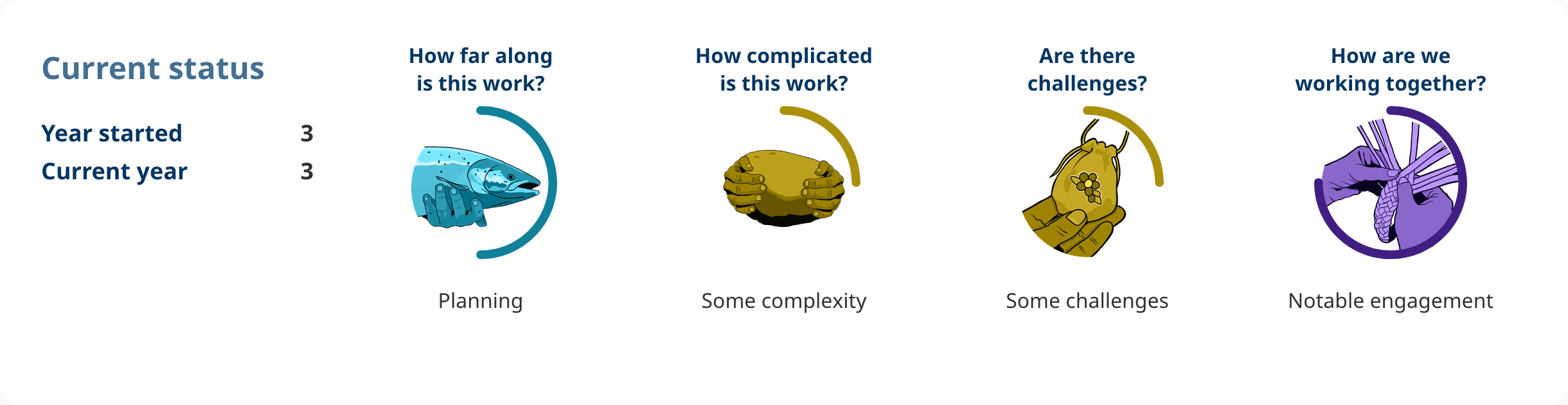
How are we working together?
The Ministry of Housing and Municipal Affairs (HMA) has established a relationship with Tla’amin Nation staff during work on Action 4.27, including regular virtual meetings to discuss progress on Action 4.27. During 2025, ministry staff developed a draft engagement plan and sought and incorporated feedback from Tla’amin Nation staff and the Declaration Act Secretariat. Prior to seeking broad feedback on a draft engagement plan for Action 4.27, ministry staff intend to take time to gather additional perspectives on the approach from other ministries and partners in 2026.In the context of a distinctions-based approach, it is important that the language, culture, heritage, history and land-based connections of the First Nation(s) on whose territory a local government is located are honoured, acknowledged and understood by communities across B.C. Ministry staff recognize that local government names and local First Nations’ interest in those names will be unique across the province and that the local context, history and reconciliation priorities will be different in each.
Are there challenges?
Ministry staff plan to seek further input from other sectors and clarification on the overall strategy and approach to Action 4.27 to support alignment across naming work more generally. There is some risk that this may slow down planning next steps for this work; however, understanding the interests and perspectives of other ministries and sectors involved in naming work may support this work broadly. Additionally, there are capacity limits that are impacting the pace of progress on this work.
In addition, ministry staff intend to explore connections between other streams of work, including the Anti-Racism Act and other provincial sectors involved in naming to consider how to support community conversations about First Nations place names and naming generally. These conversations must consider how to confront Indigenous-specific racism and support cultural safety during engagement processes. These discussions can have a negative impact on First Nations who are facing intergenerational trauma and experience systemic racism in B.C. and Canadian society.
Local discussions about First Nations place names reveal that there are diverse views on the matter, and it can be challenging for locally elected officials, local government staff and local First Nations to manage these discussions and related processes. While aspects of this work have no easy answer or pathway to follow — particularly where racist attitudes surface — the development of guidance may assist with managing these challenges.
Highlights
The restoration or reclamation of First Nations place names is identified in the United Nations Declaration on the Rights of Indigenous Peoples and Canada’s Truth and Reconciliation Commission Calls to Action as an important reconciliation step. It is part of recognizing, preserving and strengthening Indigenous histories, languages and cultures. Guidance materials that are co-developed with First Nations and local government partners will be a first step to supporting local governments and First Nations to better understand the work they can do together to support the revitalization of First Nations place names locally.
While considerable work has been completed on a draft engagement plan for Action 4.27, ministry staff recognize the interconnectedness of this work with that of other ministries and plan to take time in 2026 to explore approaches to naming across sectors. These discussions will further inform Action 4.27 and highlight the ongoing work being done on First Nations language revitalization and place names across the province.
Previous years’ progress
Highlights
The restoration or reclamation of First Nations place names is identified in the United Nations Declaration on the Rights of Indigenous Peoples and Canada’s Truth and Reconciliation Commission Calls to Action as an important reconciliation step. It is part of recognizing, preserving and strengthening Indigenous histories, languages and cultures. Guidance materials that are co-developed with First Nations and local government partners will be a first step to supporting local governments and First Nations to better understand the work they can do together to support the revitalization of First Nations place names locally.
As a part of this work, ministry staff developed a network of provincial ministries that have a role in naming to better understand how different entities are named (e.g., geographical features, school district names, infrastructure and roads). This outreach has shown the growing variety and depth of work that is being done to support First Nations language revitalization and place names across the province.
Ministry staff have also reached out to several municipalities and regional districts to understand local policies (e.g., streets, parks) and processes around naming (including the restoration of First Nations place names). Research has also included an analysis of past local government name changes, including the Village of Daajing Giids, to learn from and adapt the guidance.
How are we working together?
When action planning work got underway, the ministry started to build a relationship with Tla’amin Nation staff. Since 2024, that relationship has evolved into regular virtual engagement meetings to discuss Action 4.27 and to collaboratively begin developing draft guidance materials that can be used to support this action.
In the context of the distinctions-based approach, it is important that the language, culture, heritage, history and land-based connections of the First Nation(s) on whose territory a local government is located, are honoured, acknowledged and understood by communities across B.C. Ministry staff recognize that local government names and local First Nations’ interest in those names will be unique across the province and that the local context, history and reconciliation priorities will be different in each.
Ministry staff intend to expand engagement on Action 4.27 to other First Nations across B.C. to gather input.
Are there challenges?
Planning has begun for engagement with First Nations and First Nations organizations, as well as local governments and local government organizations, to understand their interests and collect feedback to further inform this work.
Depending on the level of interest, there is a risk that there may not be enough resources to effectively engage. However, it’s important to engage in this dialogue across the province to capture different perspectives and interests and inform the materials developed as part of Action 4.27.
Community conversations about First Nations place names must consider how to confront Indigenous-specific racism and support cultural safety during engagement processes. Colonial names and the process of discussing them can have a negative impact on First Nations who are still living under a colonial system of government, are facing intergenerational trauma and experience systemic racism in B.C. and Canadian society.
Local discussions about First Nations place names reveal that there are diverse views on the matter, and it can be challenging for locally elected officials, local government staff and local First Nations to manage these discussions and related processes. While aspects of this work have no easy answer or pathway to follow — particularly where racist attitudes surface during local engagement meetings and discussions — the development of guidance may assist with managing these challenges.