
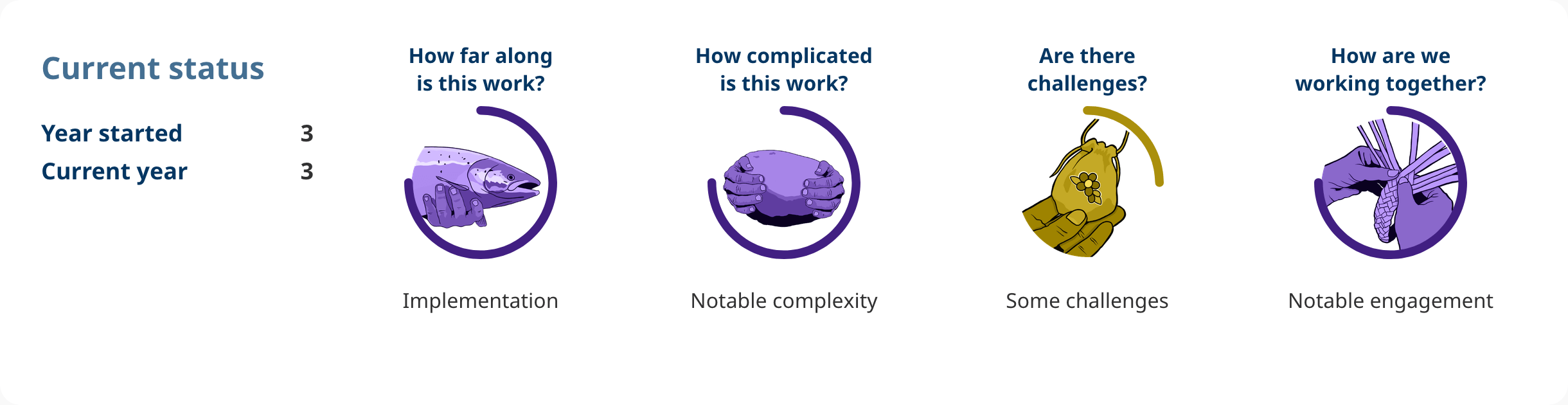
How are we working together?
The Ministry of Health continues to work in partnership with Indigenous partners to advance Indigenous-led treatment, recovery and aftercare services across the province. This includes collaboration with First Nations Health Authority (FNHA), First Nations, Tribal Councils and First Nations communities.
Ministry staff are partnered with FNHA to advance the tripartite MOU First Nations treatment centre projects, replacing six existing First Nation-run treatment centres and building two new ones.
Ministry staff participate in working groups under the Indigenous, Treatment, Recovery, and Aftercare Services (ITRAS) Program, bringing together First Nations, regional health authorities, service providers and other parties to guide service planning and implementation.
The Province partners with Community Action Initiative and FNHA in the co-development of the Capacity Building Grant call. These grants support organizations in improving delivery of treatment and recovery services.
The Canadian Mental Health Association BC, in partnership with the Province, FNHA and Métis Nation British Columbia, completed a rigorous process of selecting service operators to administer and implement 307 grant funded treatment and recovery beds. The application design and adjudication process was done in collaboration with FNHA. Providers must demonstrate how their policies and procedures foster an environment that is non-discriminatory and anti-racist.
Primary Care
Health Services Integration Division conducts regular partner meetings with FNHA to support primary care program implementation and oversight. There is a plan to engage partners including First Nations, Métis, and Inuit healthcare providers and patients to provide feedback on how to improve Primary Care funded virtual care services.
Are there challenges?
Treatment and Recovery
Timelines for advancing some major projects are affected by construction and workforce challenges, as well as by rising project costs. Partner organizations each have their own processes and requirements and the partners have worked together to streamline. The need for treatment and recovery services has increased pressure to accelerate implementation timelines and expand capacity.
Primary Care
Increasing demand for these services from First Nations communities are outpacing the availability.
Highlights
In 2025/2026, the Province invested $8.3 million in initial funding for the Tŝilhqot’in-led healing and wellness model near Hanceville. The new Red Road River Tŝilhqox model is founded on the strength of Tŝilhqot’in culture and will offer traditional treatment and land-based healing. The project will provide a continuum of care for adults, including supportive recovery beds (pre-treatment), treatment and recovery beds at Tŝilhqot’in Healing and Wellness Centre and beds for aftercare, reintegration and long-term healing (post-treatment).
The ministry supports operating funding for the Orca Lelum Youth Wellness Centre, which offers 10 substance-use treatment beds for Indigenous People aged 12-18 years struggling with substance use and mental health issues, including intergenerational trauma. The ministry secured funding to support operational costs for the Tsakwa’lutan Healing Centre, led by the We Wai Kai First Nation, which provides culture-based treatment and supportive recovery programming (32 publicly funded beds for adults as of February 2026).
The ministry continues to work with the Northern First Nations Alliance to develop Indigenous-led treatment and wellness services in the northwest. A new 12-bed treatment centre, Red Road North (“The Lodge”), located outside of Terrace is now open (announcement – March 27, 2026).
Through the 2025 Capacity Building Grant call, 15 Indigenous-led organizations each received one-time funding of $25,000 to enhance capacity and support delivery of treatment and recovery services focused on culture first models of healing.
There are 47.8 full-time equivalents approved at First Nations-led Primary Care Centres providing mental health and substance use supports to patients across B.C.
Previous years’ progress
Highlights
Progress continues to be made on major projects funded through the Indigenous Program.
In 2024/25, the Province invested $7 million in initial funding for the Orca Lelum Youth Wellness Centre in Lantzville. With support from the FNHA, this centre will be the first on Vancouver Island to offer detox services specifically for Indigenous youth. Through a phased implementation approach, the centre will provide 10 substance-use treatment beds and 10 detox beds (in development) that offer culturally informed care to Indigenous People aged 12 to 18 years who are struggling with substance use and mental health issues, including intergenerational trauma.
The ministry secured funding to support both capital and operational costs for the Tsakwa’lutan Healing Centre, led by the We Wai Kai First Nation (Quadra Island), which will provide culture-based treatment and supportive recovery programming. The centre was announced in July 2024 and is anticipated to have 32 publicly funded adult treatment beds.
Funding was provided to Lheidli T’enneh First Nation to support the consultation, engagement and early planning processes for a Northern Centre of Excellence for Children and Youth. Consultation processes closed May 31, 2024, with an initial consultation report shared with the ministry in July 2024.
In a collaborative effort involving the ministry, the FNHA, Northern Health and Northern First Nations Alliance, the Northwest working group was formed to address immediate service gaps and long-term system needs in B.C.’s northwest.
How are we working together?
The Mental Health and Addictions portfolio within the Ministry of Health continues to engage with Indigenous partners on its Indigenous Program. Work has taken place with the First Nations Health Authority (FNHA), Métis Nation BC (MNBC), BC Association of Aboriginal Friendship Centres (BCAFN), First Nations in B.C., Tribal Councils and First Nations communities.
The First Nations Health Authority continues to manage aspects of Tripartite MOU-funded First Nations treatment center projects alongside First Nations partners including in the areas project management, funding allocations and procurement.
Ministry of Health staff have partnered closely with the FNHA on the treatment centre initiative, replacement of six existing First Nation-run treatment centres, and building of two new ones.
Ministry staff participate in several working groups alongside project partners, including. First Nations, Indigenous-led organizations, regional health authorities and other interested parties to guide the development of each project.
The Province has partnered with Community Action Initiative, FNHA and MNBC in the co-development of the Capacity Building Grant call. The Canadian Mental Health Association BC, in partnership with the Province, FNHA and MNBC, conducted and completed a rigorous process of selecting service operators to administer all 180 grant funded beds. The application design and adjudication process was done in collaboration with the FNHA. Applicants were required to demonstrate how their policies and procedures foster an environment that is non-discriminatory and anti-racist.
The Ministry of Health’s Primary Care Division fosters strong collaborative partnerships within the FNHA to enhance the delivery of primary health care services. Through regular engagement and joint planning, the Primary Care Division and the FNHA ensure that virtual care programs are well supported, effectively implemented and continuously improved.
Are there challenges?
When supporting the implementation of Canadian Mental Health funded beds that involve a capital project (i.e. building a new service), timelines may shift often due to complexity of capital builds (construction, permitting, etc.).
Funding for Real-Time Virtual Support services is confirmed until the end of 2025/26. The Primary Care Division is engaging with the Hospital and Provincial Health Services Division, Health Section Workforce and Beneficiary Services Division and Financial and Corporate Services Division to evaluate Real Time Virtual Supports and determine future strategy to align with provincial direction beyond that date.