
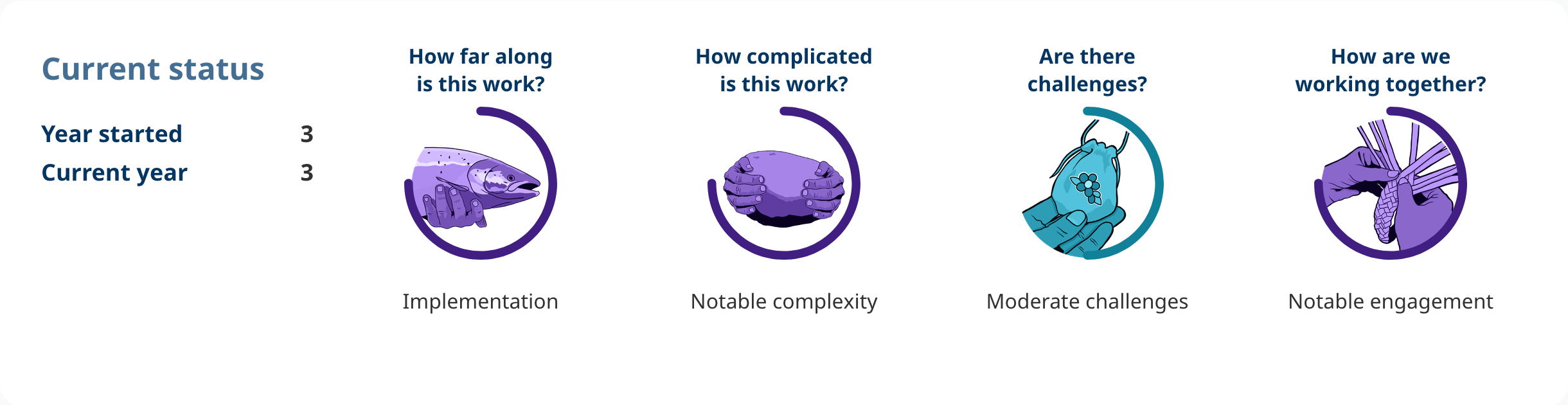
How are we working together?
In 2011, the provincial and federal governments and BC First Nations representatives signed the Tripartite Framework Agreement on First Nations Health Governance (the Framework Agreement), which was endorsed by the First Nations Health Council.
The Tripartite partners have completed the second five-year evaluation of the implementation of the Framework Agreement, covering the period from 2019-2023.
Entering the 15th year following the signing of the Framework Agreement, the Tripartite partners acknowledge that the successes and progress to date is helping to identify new needs, priorities and perspectives. There is a growing awareness of new challenges and opportunities for improvement. In response, partners are considering how to evolve the Tripartite health partnership to meet these challenges and establish stronger foundations for greater success and progress in the years ahead.
The ministry is working with the Ministry of Indigenous Relations and Reconciliation (MIRR) to ensure meaningful engagement with Modern Treaty Nations (MTNs) and the Province’s distinct relationship with MTNs is upheld and prioritized.
The ministry is also working in partnership with 3Nations Society and First Nations Health Authority to improve health outcomes for Tahltan, Kaska and Taku River Tlingit community members, reinforcing a shared commitment to reducing inequities for communities across the province’s northern corridor. This work continues to be supported alongside MIRR to advance relationships and remove barriers.
Are there challenges?
The Province continues to advance engagement and co-operation with First Nations, health governance partners and organizations. This includes evolution of the Tripartite health partnership to meet the current needs and perspectives of First Nations. The ministry continues to engage in discussions with Nations related to direct government-to-government relationships and shared decision making.
The ministry is actively engaging in productive conversations with partners to identify critical priorities and next steps to best support tripartite initiatives.
Establishing spaces that support meaningful joint decision-making at the local, regional and provincial levels continues to be an evolving and complex process. Work is ongoing across sectors, regions and governance structures to strengthen coordination and create environments where partners can work together effectively.
The second evaluation of progress on implementing the Tripartite Framework Agreement on First Nations Health Governance, covering the period 2019-2023, has now been completed. Tripartite partners are collaboratively developing an action plan to address the recommendations outlined in the report, with a shared focus on reducing barriers and i
Highlights
In June 2025, Tripartite partners released the second five-year independent Evaluation of the BC Tripartite Framework Agreement on First Nation Health Governance (2018/19-2023/24). The evaluation found that the governance structure created under the Framework Agreement is established and that partners have largely fulfilled or are actively working to fulfill their respective mandates and roles. It noted that relationships among partners have strengthened over time and that the governance model has been effective in bringing provincial and regional partners together to work collectively toward shared system transformation goals.
In January 2026, the Éyameth’ Health Centre opened, providing culturally safe health services open to all Indigenous and non-Indigenous people in the North Fraser Region. The initiative is a partnership between the ministry, the Fraser Health Authority, First Nations Health Authority and Sts’ailes First Nation.
In February 2026, the ministry, in partnership with 3Nations Society (Tahltan, Kaska, Taku River Tlingit First Nations), signed a Transformational Health Declaration, providing the framework to work collaboratively to achieve improved health outcomes for 3Nations communities in the northern region of the province.
Previous years’ progress
Highlights
Renewed Fraser Partnership Accord
In February 2024, the Province renewed its commitment with the Fraser Salish Regional Caucus, Métis Nation British Columbia and Fraser Health to improve health outcomes for Indigenous Peoples in the Fraser Salish region. The Fraser Partnership Accord has been amended to include the Fraser Salish Regional Caucus and, for the first time, Métis Nation BC, as signatories and full and equal partners in decision-making and service delivery at local and regional levels. The accord was first signed in 2011 and amended in 2020, and aims to blend cultural and modern health practices to improve health and wellness for all people in B.C.
A core element of the new accord is the creation of an Indigenous Health Collaborative Council that will serve as a joint decision-making body to provide governance for Indigenous health services in the region and programs to ensure that general health services provided by Fraser Health are culturally safe and free from Indigenous-specific racism.
The accord seeks to achieve the commitments regarding health and the social determinants of health made in the Declaration Act Action Plan. The partners to this accord endorse and commit to work to implement the United Nations Declaration on the Rights of Indigenous Peoples and aim to establish a culturally safe health care system in B.C. that is free of Indigenous-specific racism through the implementation of advice and recommendations made in the In Plain Sight report. For more information, read the “Renewed partnership improves health, wellness for Indigenous Peoples” news release.
How are we working together?
The Tripartite Framework Agreement on First Nations Health Governance (the Framework Agreement) was signed in 2011 by the provincial government, federal government, and BC First Nations, and endorsed by the First Nations Health Council (FNHC). Several committees have been established under the Framework Agreement:
- Implementation Committee, which monitors the implementation of the Framework Agreement and the effectiveness of the health governance structure;
- Political Principals, which consists of the tripartite political leads and provides executive direction and governance oversight; and
- The Tripartite Committee on First Nations Health, which monitors tripartite progress towards improving health and wellness.
The tripartite partners are near completion of the second five-year evaluation of the implementation of the Framework Agreement, covering the period from 2019-2023.
The Ministry of Health is working with the Ministry of Indigenous Relations and Reconciliation and the Declaration Act Secretariat to ensure meaningful engagement with Modern Treaty Nations and the Province’s distinct relationship with Modern Treaty Nations is upheld through this process.
Are there challenges?
There is a growing interest from individual First Nations in engaging directly with the Ministry of Health to explore government-to-government relationships and supports that align with their self-determined priorities. Establishing spaces that enable meaningful joint decision-making at local, regional, and provincial levels is a complex and evolving process. Efforts are underway to support coordination across sectors, regions, and governance structures. The tripartite partners are conducting a comprehensive evaluation of progress on implementing the Framework Agreement covering the period 2019-2023. The evaluation report is slated for public release in Summer 2025.
FNHC has been engaging with First Nations to inform the development of two consensus papers that were originally intended for consideration at Gathering Wisdom XIII (13) in June 2025:
- B.C. First Nations-specific principles to guide provincial and federal health-related legislation; and
- Evolving FNHC’s role and governance structure within the broader First Nations Health Governance Structure, to reflect input from evaluation participants as well as FNHC’s updated focus to move from transfer to transformation.
To allow for more engagement and build consensus on these complex topics, the First Nations Health Authority has extended the engagement timeline. The engagement process will continue throughout Fall 2025 and Spring 2026 to continue to build consensus across communities.