
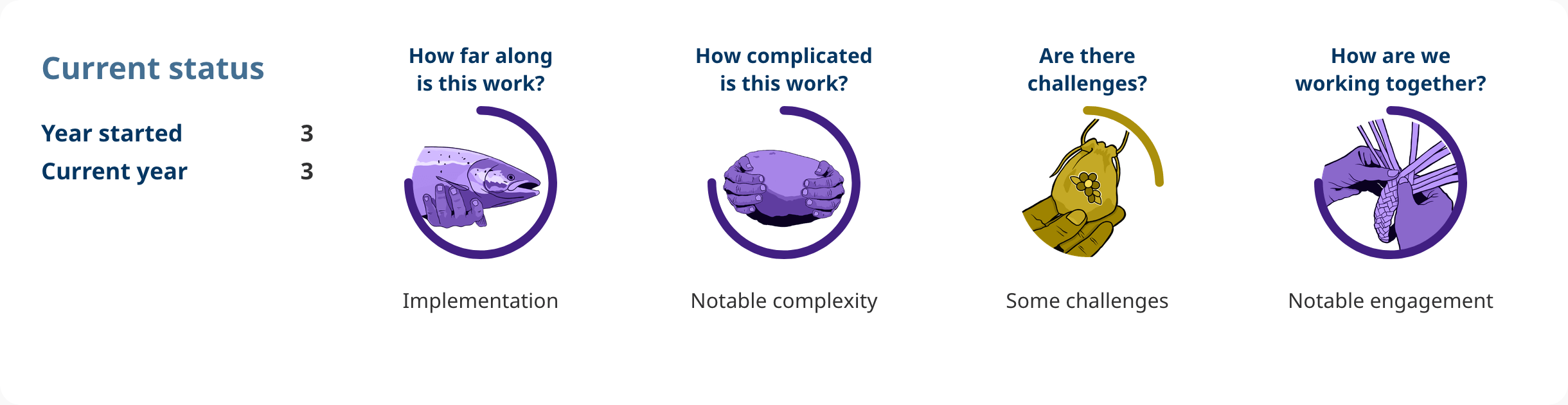
How are we working together?
Consultation and co-operation with Indigenous Peoples’ took place between July 2025 and March 2026 and focused on:
- B.C. issued ID: Gauging Indigenous Peoples support for an approach to name registration that enables access to services.
- Name registration process: Exploring Indigenous Peoples’ interest in confirming or approving names in their languages for birth and name registration.
- Service prioritization: Identifying the services Indigenous Peoples want prioritized for including people’s names in their languages.
Future consultations will explore the inclusion of Indigenous business names and place names. Early engagement on business names will begin in fiscal year 2026/2027.
A summary of what was heard during the consultation on including Indigenous language person names, and proposed actions were reviewed by consultation participants (15 First Nations and Métis Nation British Columbia) and outlines the path forward to including Indigenous person names in systems and services. Indigenous partner organizations, including the Alliance of BC Modern Treaty Nations, First Nations Leadership Council, and Métis Nation British Columbia, provided early input and advice on the consultation materials to ensure clarity of the request and relevant background information was included.
The Province is now implementing the actions identified during consultation, most significantly the use of alternate spelling on ID alongside the correct spelling of Indigenous language names to ensure access to services that don’t yet have the technical capabilities required to store, print or display Indigenous languages. There are significant technical, legislative, training and change management needs related to this work. The path forward outlined in the report includes further opportunities for Indigenous Peoples in B.C. to shape this work, including co-development with Indigenous Peoples of any legislative changes and more informal design engagement sessions with Indigenous individuals (community-level) participation. Upcoming engagement sessions are typically shared with Indigenous Peoples and community organizations to promote within their communities. Any Indigenous (First Nations, Métis or Inuit) people interested in participating can email Indigenous.Data@gov.bc.ca to request a notification of upcoming engagement initiatives.
One area identified for improvement is Inuit representation in community engagement sessions and consultation. Some promising connections have been made, and a direct connection with Inuit voices is expected ahead of future consultations.
Are there challenges?
The systems that support IDs (BC Services Card, BC Drivers’ Licence, BC Identity Card, etc.) and delivery of related services are very interconnected and require that work remain in unison across multiple organizations. This means aligning the timing of budget requests, staffing of projects, system development and testing. Strong governance and constant communication will ensure alignment to deliver on joint project timelines.
An additional challenge is ensuring alignment with Indigenous People’s ID systems so that when individuals register a name using their language with the government of B.C. that same spelling can be used in their Nation’s systems. For example, Indigenous governments that issue citizenship IDs to their citizens need to ensure expanded alphabets can be captured in their systems. To support any organization looking to update their technology to include Indigenous languages, they can reference the Indigenous Languages Technology Standard and supporting resources which outlines the technical requirements for systems to read, write, store, process and display Indigenous languages. In the meantime, while systems are updated, the alternate spelling of names can be used on IDs to ensure people who’ve registered an Indigenous language name can access services.
Highlights
Between June 2025 and March 2026 consultation and co-operation on including Indigenous Language Person Names on B.C. issued identification was completed. This included in-depth conversations or written correspondence with 15 First Nations and Métis Nation British Columbia.
Feedback from various stages of the consultation process includes:
“I just think this is great to see the development and that this is occurring and it’s big, it shows the reconciliation that is happening within…[And], as Indigenous Peoples that we can provide the opportunity for our members to honour and share and have their traditional names present. I think it would be really good…great for reconciliation, recognition, and for their own personal spirits to be able to have that honored and recognized is incredible.”
“Overall, we feel this report incorporates most of our Nation’s feedback. The topic is complex, and we believe the Province is approaching it in a good way.”
Following the consultation that took place, an implementation plan was developed in collaboration with internal partners to support the issuance of B.C.-issued ID with both the correct Indigenous language name and alternate spelling printed on them.
Given that people use their name across multiple jurisdictions, alignment across federal, provincial and territorial governments is essential to providing equitable service. The Government of B.C. confirmed that the actions identified through B.C.’s consultation with Indigenous Peoples align with approaches and service delivery processes and practices and will support Indigenous people accessing services beyond the Government of B.C.
Previous years’ progress
Highlights
Between May 2023 and October 2024, the BC Data Service hosted three engagements to understand the needs of Indigenous People who wish to register an Indigenous name, and to explore options for how to include names. Materials for consultation with First Nations are currently being reviewed and approved.
Feedback from the engagement sessions was positive; one participant’s remarks in response to the engagement summary report was: “The team presenting this information were very knowledgeable about the culture and our names. They did their [re]search and further to that applied what they had learned. I felt seen. I felt valued and I felt heard. I really appreciated the visual presentation. The team leading this process are to be commended for a job well done. I raise my hands in thanks [to] you all.”
In addition to engaging with Indigenous People, the BC Data Service interviewed service delivery staff from across the BC Public Service to identify support and tools, including training material, to help them provide services to people using Indigenous language names. The insights from this research will play a crucial role in improving the process for Indigenous People who register an Indigenous name and support safe service interactions.
How are we working together?
Indigenous People have the right to use names in their language. Any changes government makes to respect this right will be done together with Indigenous Peoples in B.C. so that it can be done correctly. The ministry is engaging Indigenous Peoples and community members in a few ways:
- Consultation and co-operation with First Nations – to align laws, design solutions and prioritize the services most important to Indigenous Peoples.
- Community level engagement to understand people’s needs around specific services.
To date, three community level engagements regarding including Indigenous names on ID have taken place. The Alliance of BC Modern Treaty Nations, the First Nations Leadership Council and Métis Nation BC have provided input on the project and consultation approach.
The Province anticipates that consultation with First Nations to define how government includes Indigenous Persons’ names on ID will take place this year. This consultation builds on the input the Province has received from community members. The Province is grateful for the contributions of each participant. Consultation regarding place names and business names will be held after those on person names.
Are there challenges?
There is a risk that First Nations will not have time to consult due the number of requests for consultation they receive. To mitigate this risk the ministry is providing consultation material in a format that is easy to respond to and offering a variety of ways to engage so that First Nations can select an option that meets their capacity. Furthermore, the ministry attended the January 2025 B.C. Cabinet and First Nations Leaders’ Gathering as an exhibitor to increase awareness of the upcoming consultation and identify specific contacts to receive the materials.
People’s lives occur across the boundaries of provinces, territories, and nations. Indigenous People may experience additional harm if the work the Province does to advance inclusion of Indigenous language names doesn’t align with the delivery of programs and services in other jurisdictions. To mitigate this risk, the Province is working closely with provincial, territorial, and federal partners to ensure the changes B.C. makes maintain access to services when individuals accessing services have an Indigenous language name. This includes providing standards and templates other organizations and jurisdictions can use in their implementation and an interim approach that will be compatible with systems and services that currently cannot process Indigenous language characters.