
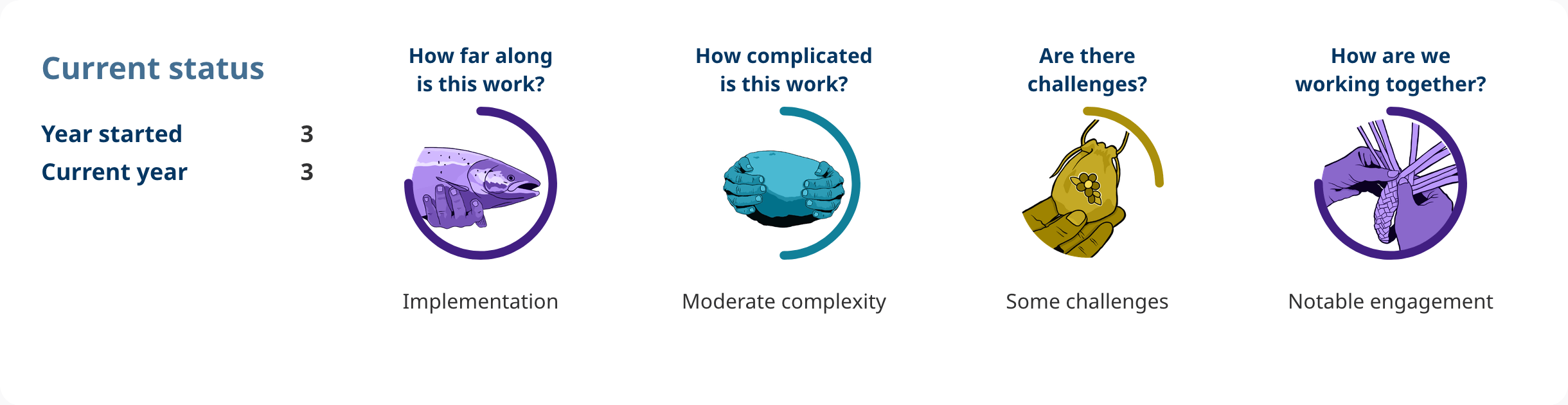
How are we working together?
Under the Ministry of Citizens’ Services (CITZ) and First Nations Leadership Council (FNLC) protocol, CITZ held three technical-level meetings and one additional joint meeting with FNLC since April 2025 to coordinate work related to the Declaration Act Action Plan and Anti-Racism Data Act. CITZ is supporting FNLC in advancing Regional Information Governance Centre (RIGC) demonstration projects that support Nations’ community data capacity. As part of raising awareness across the Provincial government, CITZ facilitated an RIGC briefing for the Deputy Minister Committee on Digital and Data on November 27, 2025, helping situate Indigenous data governance within broader digital and data priorities.
CITZ held six Zoom Circle meetings with Indigenous governing entities (IGEs) from April 2025 to March 2026, with attendance ranging from 10 to 22 participants. The September meeting agenda was collaboratively driven by Nations, who used the forum to share successes and lessons learned in their data initiatives.
Notification letters for consent were sent to 575 IGE emails on March 28, 2025, for 2025 Release of Statistics and 2025-2027 Research Priorities. Consultation and co-operation meetings continue throughout the year.
CITZ also finalized the co-developed, updated Indigenous Identity Data Standard with Indigenous Peoples, including IGEs and Indigenous partners (FNLC, RIGC, Métis Nation British Columbia). Feedback was sought from Vice Presidents of Indigenous Health, the Indigenous Physician Advisor of Office of the Provincial Health Officer, the Ministry of Indigenous Relations and Reconciliation, the Declaration Act Secretariat and the Indigenous Employees Network. The data standard was sent to IGEs for consent in October and finalized in January 2026.
Are there challenges?
Consultation and co-operation with IGEs is limited by available capacity and funding. CITZ capacity restraints remain an obstacle to support program implementation. In addition, Nation governments face many demands on their time and expertise, often with limited or no compensation.
Highlights
During the 2025/2026 reporting period, CITZ continued to advance Action 3.14 through sustained consultation and co-operation with IGEs and Indigenous partners on priority data initiatives.
CITZ refined multiple engagement and consultation and co-operation mechanisms, including Zoom Circles, technical-level meetings and protocol-based coordination with FNLC. These approaches supported legislative requirements and improved data initiatives (e.g., research priorities, and annual Release of Statistics).
A key milestone was the co-development and publication of the Indigenous Identity Data Standard, which gives a standardized and culturally safer way of asking about Indigenous identity, only where needed for program delivery or anti-racism purposes. The new Racial Identity Standard will supplement the Indigenous Data Standard by ensuring people with multiple racial identities (e.g., Black and Indigenous) will be accurately reflected in the data collected by the Provincial government. Together, these standards advance a distinctions-based approach to Indigenous data sovereignty and self-determination and lays the groundwork for improved data quality, trust and accountability across the Provincial government.
CITZ supported FNLC in advancing demonstration projects under the RIGC, which are designed to strengthen Nations’ community data capacity and inform the future RIGC service model. As part of convening support across the Provincial government, CITZ facilitated an RIGC briefing for the Deputy Minister Committee on Digital and Data, helping to situate Indigenous data governance within broader digital and data priorities. One supported project focuses on establishing a First Nations-controlled membership database system, with inputs from Vital Statistics, to support a trusted source of truth governed by Nations.
Previous years’ progress
Highlights
The ministry, though BC Data Services, established a protocol agreement with FNLC to formalize ongoing Declaration Act Action Plan activities and work under the Anti-Racism Data Act. The protocol aligns with the ministry’s activities to collaborate directly with rights and title holders in the province. The protocol does not replace consultation, and regular meetings between the ministry and FNLC are held to discuss progress.
In its action plan commitments and in implementing Anti-Racism Data Act, the ministry is building capacity to meaningfully engage with Indigenous governing entities.
The Anti-Racism Data Act requires consultation and co-operation with Indigenous governing entities for data initiatives, such as research priorities, which have timelines set in legislation.
The Province has worked to iteratively improve its consultation and co-operation mechanisms. This has helped the ministry meet legislative requirements, while also improving data initiatives (e.g., research priorities and annual release of statistics).
This approach also reinforced Indigenous governing entity demand for progress on Action 3.14 (via Anti-Racism Data Act research priorities) and this interest has been leveraged to share communications about and build interest in Regional Information Governance Centre progress with FNLC to determine next steps for Indigenous governing entity involvement.
The Indigenous identity data standard will provide a standardized way of asking about Indigenous identity, asking only where needed for program or anti-racism purposes, which will reduce harm and support cultural safety. The new racial identity standard will supplement the Indigenous data standard by ensuring that people with multiple racial identities (e.g., Black and Indigenous) will be accurately reflected in the data collected across the provincial government. This work advances a distinctions-based approach to Indigenous data sovereignty and self-determination.
BC Data Services is supporting FNLC to advance demonstration projects that support title and rights holders with their data priorities which will inform the service model for Regional Information Governance Centre. One of the projects that BC Data Services is supporting, and for which work is underway, involves establishing a membership database system with inputs from Vital Statistics and the Indian Register to support a source of truth controlled by First Nations governments.
How are we working together?
Under the joint protocol between the Ministry of Citizens’ Services and the First Nations Leadership Council (FNLC), BC Data Services held five technical level meetings with the FNLC since April 2024 to discuss and coordinate work related to the Declaration Act Action Plan and Anti-Racism Data Act. BC Data Services is supporting FNLC in advancing demonstration projects under the Regional Information Governance Centre that support Nations’ community data capacity.
BC Data Services held four Zoom circle meetings with Indigenous governing entities from April – August 2024, abstained from meetings during the provincial election and interregnum phase, and resumed in December 2024 and January 2025.
The ministry is co-developing the updated Indigenous Identity Data Standard with Indigenous Peoples, including Indigenous governing entities and Indigenous partners (FNLC, First Nations Information Governance Centre). The ministry has also engaged and sought feedback from VPs of Indigenous Health, the Indigenous Physician Advisor of the Office of the Provincial Health Officer, the Ministry of Indigenous Relations and Reconciliation, the Declaration Act Secretariat, and the province’s Indigenous Employees Network.
Letters of notification for consent were sent to 586 Indigenous governing entity email addresses in late March 2025 for 2025 release of statistics and 2025-2027 research priorities. Consultation and co-operation meetings are planned with Indigenous governing entities throughout 2025, as well as ad-hoc meetings as requested by Indigenous governing entities.
Are there challenges?
Consultation and co-operation with Indigenous governing entities is limited by available capacity and funding. First Nation governments face many demands on their time and expertise, often with limited or no compensation.
Coordination with Government of Canada is improving but insufficient on engaging Nations and developing policies for data sharing. The ministry is seeking greater clarity on federal initiatives related to the National First Nations Information Governance Centre strategy implementation from Statistics Canada, Indigenous Services Canada, and Crown-Indigenous Relations and Northern Affairs Canada. The federal United Nations Declaration on the Rights of Indigenous Peoples Act Action Plan (June 2023) suggests promising alignment.
Mitigation measures in place include ministry participation in regular technical level meetings with FNLC under the protocol. Other challenges include the ministry’s ability to support program implementation due to capacity restraints.