
How are we working together?
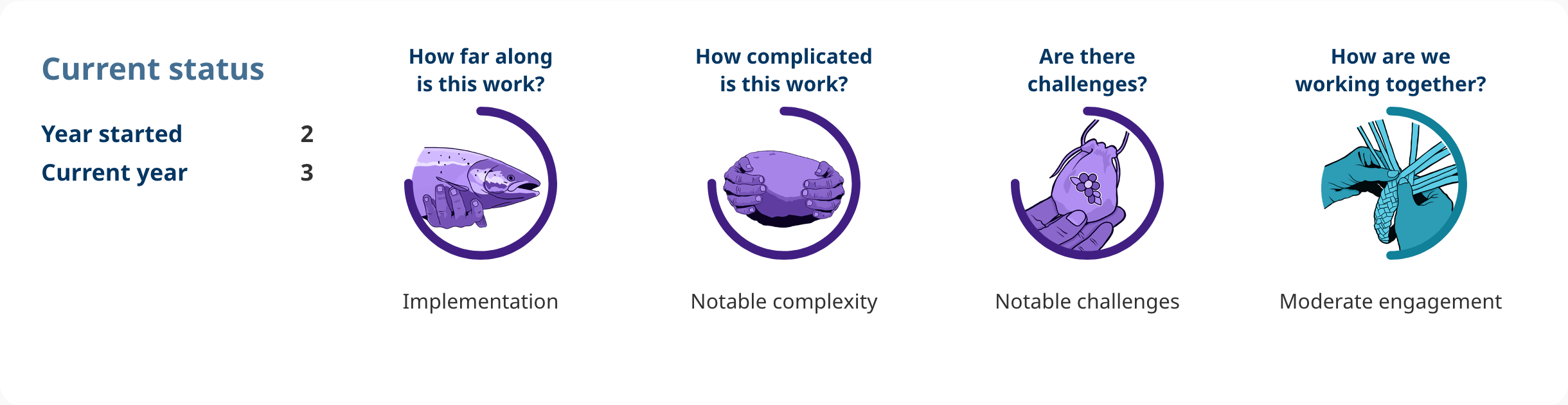
After undertaking an extensive partner and community engagement process, which was described in the previous annual report, staff from the Ministry of Public Safety and Solicitor General (PSSG) worked directly with colleagues from the First Nations Leadership Council (FNLC) and the BC First Nation Justice Council (BCFNJC) throughout the spring and summer of 2025. This work focused on consolidating the range of input that was gathered during consultations into a comprehensive inventory of potential policy alternatives for provincial government consideration. Direction was provided to ministry staff in early 2026 regarding the next area of focus for policing reforms. The immediate focus will be to establish a peacekeeper (i.e., safety officer) model for First Nations and local governments.
Additionally, the FNLC and the BCFNJC policing and public safety modernization (PPSM) working group participated in several detailed consultations with PSSG policy staff throughout 2025/2026, to provide input on regulations stemming from the Police Amendment Act, 2024. These regulations were built upon, and brought into force, important changes to the policing and public safety landscape, including:
- Expanding the oversight mandate of the Independent Investigations Office to include civilian detention guards, including in RCMP-policed communities.
- Introducing a code of conduct and training requirements for municipal police boards.
- Expanding the discipline authority qualifications for police misconduct investigations.
First Nations PPSM working group members contributed to meaningful changes being incorporated into these regulations before they were brought into force. Feedback has also been sought from this working group regarding the regulations associated with the Firearm Violence Prevention Act.
The implementation of Crisis Response, Community Led (CRCL) teams, in partnership with local non-profit operators, is led by the Canadian Mental Health Association, BC Division. Three CRCL teams are operating with local Indigenous partners: K’ómoks First Nation, Prince George Native Friendship Centre, and Kamloops Aboriginal Friendship Society. Future updates regarding this portion of the action will be provided by the Ministry of Health when relevant program changes occur.
Are there challenges?
Policing legislation is highly complex and heavily intertwined within the broader justice, public safety and social service systems. Policing involves all levels of government. The RCMP are impacted differently by elements of provincial policing legislation compared to municipal police departments. Additionally, making transformative change in policing requires increased fiscal costs for both the Province and municipal governments. Increasing costs associated with policing during a time of fiscal restraint is a challenge. Systemic reforms to policing legislation are difficult to achieve through an omnibus initiative and are best accomplished through iterative changes to various aspects of the system that are built upon each other.
Additionally, the Province is not considering a transition away from RCMP contract policing into an independent provincial police service at this time. As a result, some potential policing reforms that were dependent on B .C . adopting their own provincial police service are limited from further progression. For example, the RCMP and Public Safety Canada cannot be signatories to shared decision making agreements under the Declaration on the Rights of Indigenous Peoples Act because the federal government is not subject to this Act.
The PSSG team responsible for advancing this has been impacted by budgetary pressures, resulting in staff reduction.
Highlights
The Police Act regulations, collaboratively developed over 2025/2026, made a meaningful difference in realizing the objectives of this action. For instance, extending Independent Investigations Office oversight to civilian detention guards – including those in RCMP-policed jurisdictions – is likely to substantively improve the effectiveness of independent police oversight. This may also address longstanding concerns around ensuring accountability for serious incidents that occur in police lockups. Similarly, many Indigenous peoples reside in urban areas and introducing a code of conduct and training requirements for municipal police boards helps to empower police board appointees to perform their duties effectively, and in a manner befitting the best interests of the diverse communities they represent.
PSSG staff have recently begun collaborative efforts to develop a peacekeeper model for use in First Nations and a safety officer model for local government contexts. Establishing the peacekeeper model in B.C. is important because it could meaningfully advance the part of this action that seeks to “clarify the roles and responsibilities of police officers in the context of complex social issues such as mental health, addiction and homelessness”. It is envisioned that peacekeepers will work alongside police, the community and other essential services to provide locally minded public safety and law enforcement supports. Additionally, in First Nations communities, peacekeepers will likely be hired directly by the First Nation, which enables them to set the goals and priorities for the program, which increases public safety self-determination and self-governance. The legislative framework for peacekeepers also allows for the enforcement of First Nations’ laws, as prescribed under future regulations
Previous years’ progress
Highlights
In Spring 2024, an initial phase of Police Act amendments was completed and received Royal Assent. Since that time, substantial progress has been made towards completing a series of regulations that are needed to bring some of these amendments into force. Ministry staff also concluded an extensive multi-year engagement with a diverse range of partners to inform the next phase of policing and public safety modernization policy and legislative reforms, which is expected to be initiated in 2025.
The First Nations Leadership Council, the BC First Nations Justic Council, and 87 First Nations and Modern Treaty Nations participated in the consultation and co-operation process with $1.758 million in capacity funding provided to participants.
Support for those struggling with mental health and substance use issues strengthened this past year with the launch of one new Mobile Integrated Crisis Response team in Squamish in October 2024, and one new Crisis Response, Community Led team in Comox in December 2024.
How are we working together?
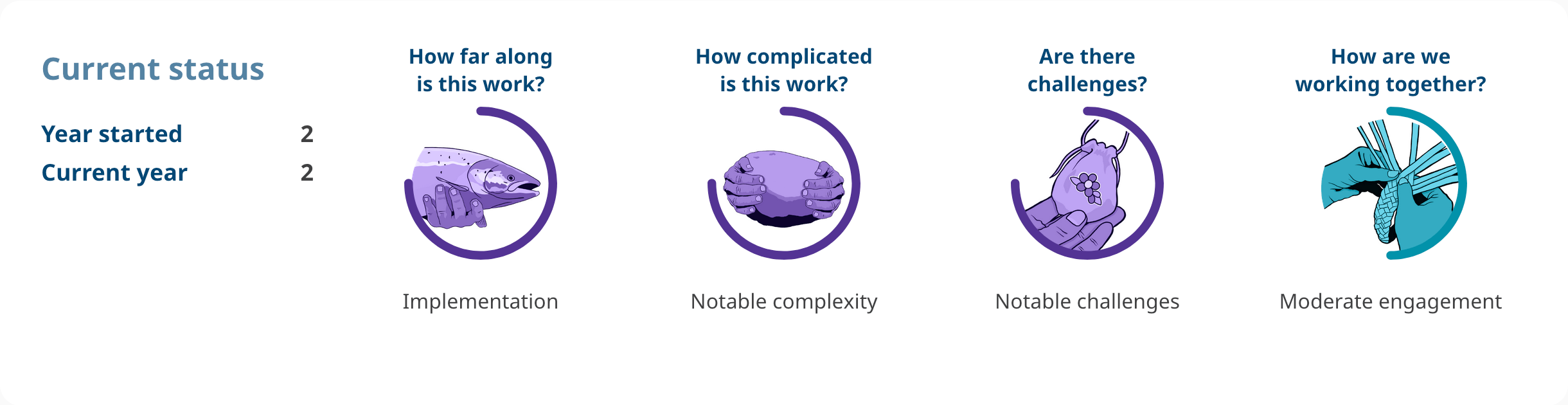
Policing and public safety policy and legislative reforms are being co-developed with interested First Nations, Modern Treaty Nations and Indigenous leadership organizations. Substantial capacity funding has been made available and provided to participants in support of this work.
Throughout the spring and summer of 2024, robust consultation and co-operation occurred with First Nations and Modern Treaty Nations through eight regional in-person meetings, five virtual policy sessions, four in-person policy workshops, and nine virtual policy workshops. In addition, the Ministry of Public Safety and Solicitor General participated in government-to-government meetings requested by First Nations and Modern Treaty Nations and has ongoing collaboration with Indigenous leadership organizations on policy co-development. The Ministry of Public Safety and Solicitor General has since summarized the feedback received and is in the process of validating this information with partners. Validation began with one in-person and one virtual session held in September 2024. Additional validation will occur in 2025/26.
Three Crisis Response, Community Led teams (formerly called Peer Assisted Care Teams) are operating with local Indigenous partners: the K’ómoks First Nation, the Prince George Native Friendship Centre and the Kamloops Aboriginal Friendship Society. The implementation of Crisis Response Community Led teams in partnership with local non-profit operators is led by the Canadian Mental Health Association, BC Division.
Are there challenges?
Due to the scale and complexity of reforming police and public safety policy and legislation, significant capacity, time, and resources are required from all partners, including Indigenous contributors, all levels of government, police, and other interested parties.
The co-development of policy and legislation remains a growing process, particularly within the topic of policing and public safety, and considerable efforts are being invested to reach a shared understanding of how to approach this work effectively.
The achievement of policing and public safety modernization objectives requires substantial human and fiscal resources, both during the policy development stage and to support resulting new programs and services. In some cases, capital funding will be needed to implement new programs. While the consultation and co-operation activities completed to this point have been well resourced, this will need to be explored moving forward to maintain progress on this action.
Staff within the ministry received extensive feedback throughout the consultation and co-operation process and through separate engagements with Indigenous organizations. In total, this input spans a wide variety of topics. Further analysis and targeted engagements will be required to identify the ideal sequencing for future actions. For this reason, ministry staff anticipate the original timing estimates for this action will need to be extended to promote effective collaboration.
Highlights
At the end of the 2023/24 reporting cycle, the Ministry of Public Safety and Solicitor General was preparing to introduce the first phase of Police Act legislative amendments, which are focused on municipal police governance and oversight, and represent an interim step towards longer-term and broader legislative modernization. The bill includes over 80 amended sections and 40 new sections, as well as numerous consequential amendments to 22 other provincial statutes. By March 2024, the ministry had distributed grants to support community-led engagement with diverse and intersectional British Columbians and provided capacity funding to First Nations and Modern Treaty Nations for co-development of policing policy during the second phase of legislative work.
Beginning in February 2024, the Ministry of Mental Health and Addictions initiated an engagement process to discuss Indigenous-led mental health crisis response services.
As a complement to these policing and mental health policy reform efforts, in July 2023 the Province announced the locations for three new peer assisted care teams and nine new mobile integrated crisis response teams. Six of the new mobile integrated crisis response teams were launched between October 2023 and January 2024.
A total of $1.536 million in funding was provided by the Ministry of Public Safety and Solicitor General in 2023/24 to interested First Nations (all 200+ First Nations and Métis Nation BC were invited to apply), the First Nations Leadership Council, the BC First Nations Justice Council and community organizations, to support capacity and engagement for the second phase of policing policy co-development. This amount included 37 community-led engagement grants totaling $0.350 million, including five engagement grants for urban Indigenous-serving organizations totaling $0.050 million; and capacity funding for over 50 First Nations, Modern Treaty Nations and leadership organizations totaling $1.186 million.
Three peer assisted care teams are currently operational in the North Shore, New Westminster and Victoria. Three additional peer assisted care teams are in the process of being implemented in the Comox Valley, Kamloops and Prince George. Seven mobile integrated crisis response teams are currently operational in Abbotsford, Port Coquitlam/Coquitlam, Burnaby, Chilliwack, Penticton, Vernon and the West Shore. Two additional mobile integrated crisis response teams are in the process of being implemented in Squamish and Prince Rupert.
How are we working together?
The new policing and oversight legislation will be co-developed with interested First Nations, Modern Treaty Nations and Indigenous leadership organizations such as the BC First Nations Justice Council. Capacity funding is available to support this work. A draft consultation and co-operation plan has been developed to ensure meaningful co-development at each stage of the policy and legislation development process.
Robust engagement with First Nations and Modern Treaty Nations is underway with support from Deloitte’s Nation building advisory services team. Eight in-person regional sessions took place in March 2024. Over 20 virtual and in-person sessions are scheduled to take place over the summer of 2024 focused on co-developing policy that will become the foundation of new policing and police oversight legislation. The ministry is also meeting with First Nations and Modern Treaty Nations who wish to participate in government-to-government meetings outside of the consultation sessions.
The Ministry of Mental Health and Addictions is working with Mahihkan Management to conduct engagement on Indigenous-led crisis response. Mahihkan Management has conducted 10 Indigenous engagement sessions throughout the province in both in-person and virtual formats, with two more sessions to come. Engagement sessions were open to all Indigenous Peoples in B.C., including First Nations, Métis and Inuit. Mahihkan Management is also offering an engagement survey for those who wish to contribute in a written format. These engagements will inform potential development of Indigenous-led mental health crisis response models in B.C.
Are there challenges?
Due to the scale and complexity of co-developing new policing and police oversight policy and legislation, significant capacity, time, and efforts are required of First Nations, Modern Treaty Nations and Indigenous leadership organizations to meaningfully participate in the co-development process. For this process to be effective, partners are required to arrive at a shared understanding of the policy and legislation co-development process and there is limited experience and best practice available to partner groups, the ministry and within government in general.
Capacity and resources also need to be secured to plan for and implement the reformed policing policies and programs once new legislation has been enacted, which could include but is not limited to the creation of new police oversight and training models.
Given the scale, complexity and funding implications associated with this initiative, some reforms desired by partners may need to be prioritized over others to ensure meaningful progress can be made in the key areas. Staffing numbers and experience, in addition to partner capacity, remain key considerations in the successful completion of policing policy reforms.
To effectively implement new mobile integrated crisis response teams, health authorities and the RCMP must determine roles and responsibilities.