
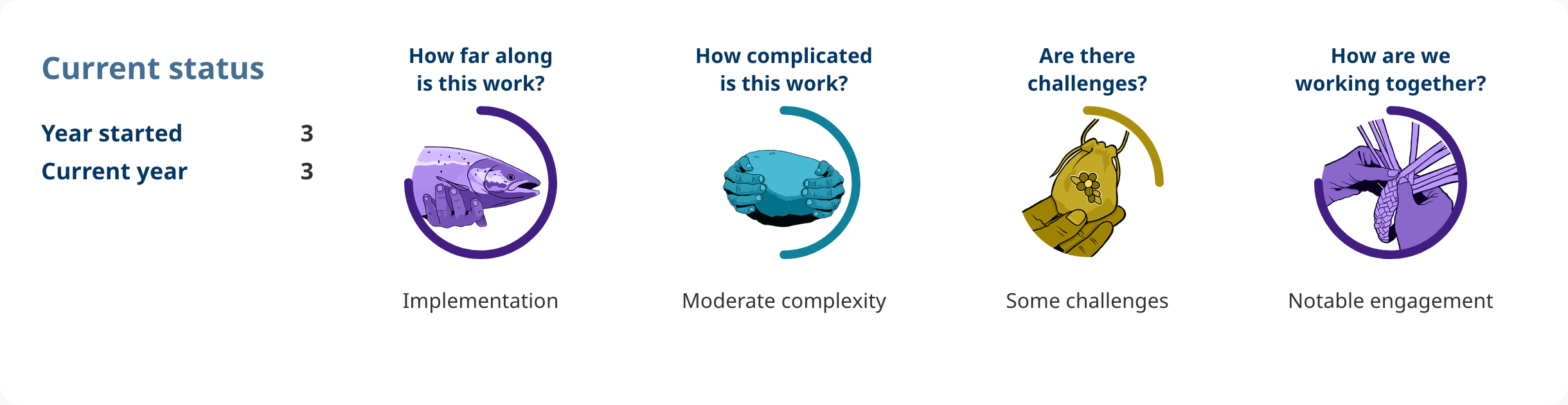
How are we working together?
In 2023/2024, the Ministry of Transportation and Transit engaged with First Nation communities, governments, hereditary chiefs and First Nation organizations across B.C. on Action 3.09, along with four other transportation initiatives.
Joint engagement and the use of varied engagement approaches with First Nations allowed the ministry to hear directly about transportation gaps and challenges faced by First Nations. The approach helped reduce confusion, engagement fatigue and ensure that First Nations partners did not have to repeat information.
During the initial engagement, more than 60 communities and four First Nations partners – First Nation Leadership Council, Union of BC Indian Chiefs, BC Assembly of First Nations and the Alliance of BC Modern Treaty Nations – provided in-depth feedback, resulting in a ‘what we heard’ report.
In 2024/2025, the ministry re-engaged with 15 First Nations communities and the Alliance of BC Modern Treaty Nations to validate the report’s findings and provide updates on the five transportation initiatives. The ministry continues to meet with the BC Assembly of First Nations to discuss transportation-related initiatives, challenges and opportunities.
Action 3.09 has enabled the ministry to gather direct feedback from more than 73 First Nation communities and four First Nation Organizations. This feedback continues to inform the development of transportation initiatives aligned with partners’ priorities and guidance.
Are there challenges?
The Ministry of Transportation and Transit intends to continue engaging with First Nations, providing resources, and help make connections that could support First Nations’ development of multi-modal transportation solutions.
Over the next several years, capacity, resourcing and budget are factors to be addressed for managing the implementation of Action Item 3.09. Engagement also has increased expectation on the ministry to develop or expand programs.
The ministry continues to approach Action 3.09 collaboratively and is working across divisions to develop actions or opportunities that respond to the challenges and areas of support outlined in the ‘what we heard’ report.
Highlights
The Ministry of Transportation and Transit continues to collaboratively advance Action 3.09 and is actively identifying projects and initiatives that support its objectives. This work has strengthened the ministry’s ability to coordinate and support multi-modal transportation efforts across agencies and has contributed to greater transparency and collaboration.
In May 2025, the ministry released the First Nations Transportation Planning Guide, a public resource designed to support First Nation’s land-use and transportation planning.
Following engagement with 73 First Nations and four B.C. First Nation organizations between 2023 and 2025, the ministry published a ’what we heard’ report outlining the key gaps, challenges and barriers faced by First Nations.
In partnership with the Ministry of Energy and Climate Solutions, the ministry supported the BC Assembly of First Nations’ Low Carbon Transportation Forum in May 2025. The ministry participated on two panels, delivered opening remarks and hosted a booth to continue discussions on First Nations transportation priorities.
The ministry continues to collaborate with internal project teams, program areas, divisions, operational leaders, with other Provincial agencies and service delivery partners – including BC Transit, TransLink and BC Ferries – to identify initiatives informed by engagement feedback.
Previous years’ progress
Highlights
The ministry engaged with 73 First Nations and four BC First Nation organizations between 2023-2025 to understand the transportation gaps, challenges, and barriers faced by First Nation communities, resulting in the creation and publication of a what we heard report.
This feedback helped identify, action, and improve programs and projects.
- The Indigenous Access and Resiliency Program was launched in 2023/24 with an initial investment of $120 million over nine years to improve access and safety for First Nations.
- The Transit Minor Betterments Fund supports projects that improve transit experience. The program provides up to $100,000 for eligible projects aimed at improving safety, supporting partners, increasing ridership, and improving accessibility.
- The Active Transportation Infrastructure Grant Program provides cost-sharing opportunities for active transportation network planning and infrastructure. First Nations, or local governments partnering with First Nations, are eligible for 80% of the project, up to a maximum of $500,000.
The Ministry of Transportation and Transit also developed the First Nation Transportation Planning Guide based on feedback from First Nations. The guide is a practical resource designed to support First Nations as they navigate their own transportation planning projects and map out their specific transportation needs.
How are we working together?
In 2023/2024, the Ministry of Transportation and Transit engaged with First Nation communities, governments, hereditary chiefs and First Nation organizations across B.C. on Action 3.09, along with four other transportation initiatives: PlanningTogetherBC, Clean and Active Transportation, Rural, Regional and Intercity Passenger Transportation, and the Provincial Transit-Oriented Development Program.
Jointly engaging with First Nations allowed the ministry an opportunity to hear about the transportation gaps and challenges faced by First Nations. The goal of completing joint engagement was to reduce confusion, engagement fatigue and ensure that First Nation partners didn’t have to repeat themselves.
During the initial engagement more than 60 communities and four First Nations partners (First Nation Leadership Council, Union of BC Indian Chiefs, BC Assembly of First Nations and the Alliance of BC Modern Treaty Nations) provided in-depth feedback, resulting in a what we hard report.
In 2024/2025, the ministry re-engaged and met with 13 First Nation communities and the Alliance of BC Modern Treaty Nations to validate the information with a what we heard report, and provide updates on the five transportation initiatives. This report is being used to help identify, action, and improve programs and projects of the five transportation initiatives so the ministry can address the identified challenges, opportunities and additional areas of support.
The Province continues to meet with the BC Assembly of First Nations to discuss transportation-related initiatives, challenges and opportunities. The Ministry of Transportation and Transit, in partnership with the Ministry of Energy and Climate Solutions, also supported the BC Assembly of First Nations’s Low-Carbon Transportation Forum held in May 2025.
Are there challenges?
The Province intends to continue to engage, provide resources, and help make connections that could potentially assist First Nations-multi-modal transportation solutions.
Over the next few years, each component that results from the engagement represents a new net project or program to be managed internally.
The ministry continues to approach Action 3.09 collaboratively and is working across divisions to develop a list of actions or opportunities to address the challenges and areas of support outlined in the what we heard report. Competing priorities and resourcing could delay certain deliverables for Action 3.09.