
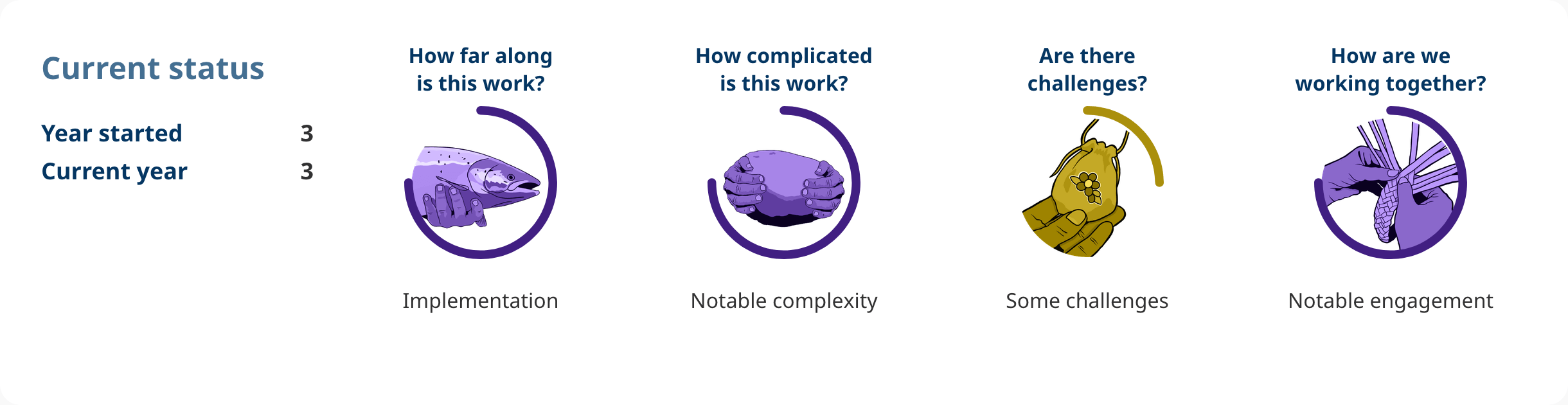
How are we working together?
Between April 1, 2025, and Feb 28, 2026, over 80 cultural and prescribed burns were completed. First Nations are leading or co-leading many of these projects. Through local place-based relationships, First Nations, provincial agencies and other partners define how best to work together and advance shared objectives. Strengthened co-development and co-delivery with First Nations in planning, coordinating and implementing safe burns has been critical to advancing Action 2.11. Partnerships are widespread and look different across regions, reflecting the unique landscapes and cultural practices of First Nations in different parts of B.C.
First Nations and provincial agencies are working together on several collaborative research projects related to Indigenous fire stewardship. These include examining the impacts of planned burning on traditional food plants; assessing ecological and socio-cultural outcomes to support cultural revitalization and relationship building; and evaluating the effects of prescribed fire and wildfire risk reduction treatments on habitat for mule deer, which is a culturally significant species for many First Nations.
Work has continued with interested First Nations to advance opportunities for fire stewardship agreements. Significant effort has gone into scoping options for distinctions-based, government-to-government approaches to cultural and prescribed fire that extend beyond individual projects. Shifting from project-by-project collaboration to a longer-term framework will continue to take shape in 2026-27.
Are there challenges?
Across the province, cultural and prescribed fire programs are scaling up. This success brings its own challenges. The size, frequency and objectives for burn projects are increasing, which means greater complexity at all stages of planning, preparing for, implementing and monitoring the outcomes of burns. The work is increasingly multi-partner and multi-faceted, requiring strong coordination, a depth of knowledge for fire practitioners and project partners that takes time to build through experience.
Highlights
In the spring of 2025, the Cariboo Fire Centre worked with the City of Williams Lake, the Williams Lake Fire Department and Williams Lake First Nation on a series of prescribed burns in and around the city. These prescribed burns are a continuation of ongoing projects from previous years and supported early season preparedness for all participants.
Over several days in early April 2025, crews carried out prescribed burns across seven sites within and adjacent to Williams Lake, treating areas ranging from six to 20 hectares. The work targeted dry, cured grasses in higher risk locations and refreshed previously treated areas where new growth and surface fuels had accumulated beneath forest canopies. All sites have a documented history of fire activity and were identified as priorities for early-season treatment.
This work brought together municipal, First Nations and provincial partners in a planned and cooperative pre-season environment. Completing joint prevention activities outside of active wildfire response supports operational alignment, strengthens interagency relationships and enhances readiness ahead of the wildfire season. This collaboration at both leadership and crew levels contributes to more effective coordination during periods of elevated wildfire activity.
These projects were delivered through co-operation between the City of Williams Lake, Williams Lake First Nation and the Cariboo Fire Centre, along with support from local contract crews and industry partners. This shared approach reflects a commitment to wildfire prevention and community protection, supported by local knowledge, operational capacity and on-the-ground experience.
Previous years’ progress
Highlights
In September 2024, in partnership with ʔaq̓am, a Ktunaxa Nation community, the First Nations’ Emergency Services Society, and the Cranbrook Zone in the Southeast Fire Centre, delivered the first-ever prescribed fire training exchange (TREX) in B.C.
There were 33 participants from 13 communities and agencies who took part in the 12-day workshop. The shared objective of Kootenay ʔa·kinq̓ uku TREX was to expand the pool of practitioners who can safely and collaboratively implement prescribed burning to the landscape such that traditional and cultural practices will be supported in the future.
This pilot project serves as a model for future TREX offerings in other regions of the province. Watch this video to learn more about the pilot project and the experiences of workshop participants.
In 2024, 48 burn projects were implemented, treating over 3,400 hectares. More than 21 burn plans were developed or co-developed with First Nations, and 23 of the 48 implemented projects from 2024 were delivered in partnership with First Nations.
One example of a co-developed and delivered project is the Flat Rock prescribed burn with the Williams Lake First Nation and Williams Lake Community Forest. Implementation of the Flat Rock prescribed burn project first started in 2022.
The fourth and final burn of this prescription will take place in 2025, achieving goals identified by the Williams Lake First Nation, Williams Lake Community Forest, and the Cariboo Fire Centre in 2020. This project demonstrates the importance of collaboration and how, by working together, shared values like cultural preservation and wildfire prevention can be simultaneously achieved. Learn more by reading the 2024 Cultural and Prescribed Fire Annual Summary Report.
How are we working together?
In 2021 and 2022, the Province engaged First Nations on Action 2.11 through local discussions and regional forums. These conversations helped identify barriers to integrating traditional practices and cultural uses of fire into wildfire prevention and land management practices.
Understanding the barriers, the Province drafted proposals for initial policy changes. The intent of the proposed policy changes was to reduce barriers and support local collaboration. In Spring 2023, the Province worked with the First Nations Forestry Council to engage on these proposals at regional forums. The B.C. government also sought input from all First Nations across the province through a consultation process.
Based on this engagement and consultation, the Ministry of Forests amended the Wildfire Act in the fall of 2023. This amendment makes it possible for the Province to assist First Nations with the use of fire for land stewardship when requested. The ministry then amended the Wildfire Regulation in the spring of 2024. This amendment provides the option for the Province and First Nations to develop agreements regarding the use of fire on the land.
The First Nations’ Emergency Services Society has been a strong partner in this work. Together, the Province and partners are striving to support the braiding of Indigenous traditional practices and cultural uses of fire with Western fire ecology and land management practices. This coordinated approach has created the space for on-the-ground partnerships with First Nations to reintroduce strategized burning.
The Province has established a continuous improvement approach to doing this work. The Ministry of Forests is actively incorporating learnings from on-the-ground implementation into policies, procedures and guidance. Over the course of 2025, the Province is working with interested First Nations on co-developing agreements for expanding Indigenous fire stewardship within their territories.
Are there challenges?
Climate change is driving changes in the environment, such as extreme drought. This can impact when it’s safe to carry out cultural and prescribed burning. Extreme fire seasons also impact shared capacity to work on burn projects.
The safety of those working on and delivering burns and the safety of the public remain a public concern and a top priority. The Ministry of Forests strives to balance these concerns with the need to expand the use of fire as a land stewardship tool. Fire projects must be delivered through a robust and inclusive planning process. This process needs to maintain public safety and safety of those working on and delivering burns. The ministry must also work to maintain and build public support for burning.
As the scale of burning increases, there is an increased demand for certified and qualified people with the skills and experience needed to do this work safely. In many areas of the Province, there may not always be enough people and resources to deliver all the approved projects in a given weather window. To help address this the Ministry of Forests is working with partners to speed up and streamline training and capacity development.
The ministry continues to focus on public education, engagement and communication to build public support for burning. In some cases, local values like conservation or recreation may limit opportunities to reintroduce beneficial fire to landscapes. In addition, discussions around liability and insurance for people delivering burn projects are ongoing.