
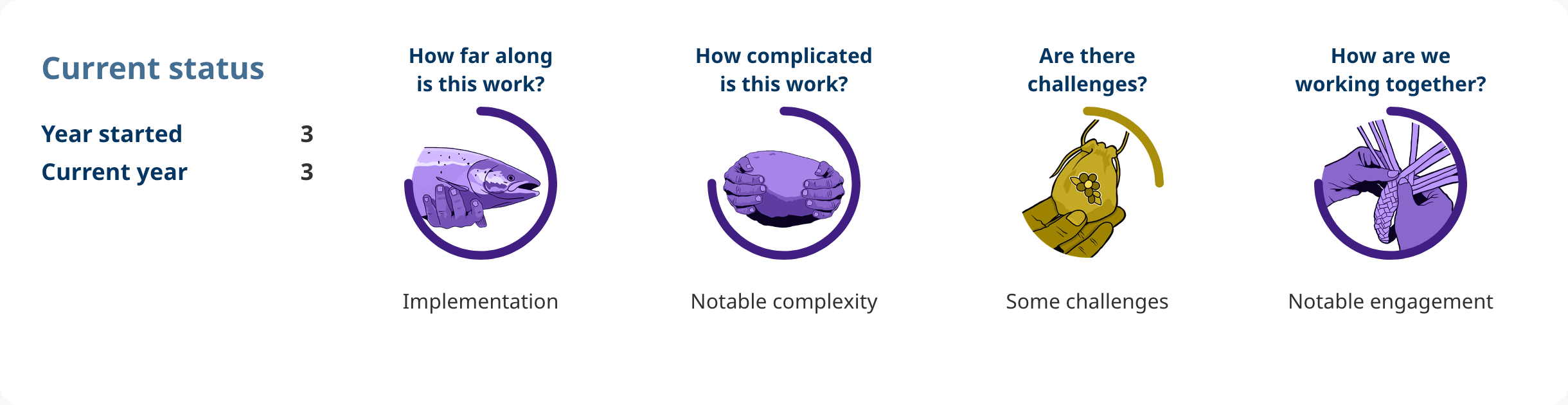
How are we working together?
Co-development of policies and approaches to negotiations requires ongoing engagement during implementation ensure agreements continue to be relevant and responsive in achieving the minimum standards of the United Nations Declaration on the Rights of Indigenous Peoples (UN Declaration).
Are there challenges?
Co-developing agreements using a distinctions-based approach require rigorous engagement with Indigenous governing bodies. Challenges in capacity across all levels of government and with First Nations partners can impact ongoing engagement. As new agreements demonstrate change and positive steps towards reconciliation, there will be increased demand on capacity.
Modern treaties and other agreements are often complex, and their scope, intent and long-term impacts can be difficult to communicate. The Province recognizes that clear and accessible communication is essential to support public understanding of how these agreements advance reconciliation, meet the public interest and uphold the minimum standards of the UN Declaration. Ongoing communication and continued engagement involving First Nations, partners and the public are key to supporting transparency and informed public dialogue.
Highlights
Examples of co-developed mechanisms in treaties, agreements and other constructive arrangements that align with the UN Declaration include the following:
- On April 10, 2025, Kitselas community members ratified their treaty and constitution, which states that its interpretation and implementation will be informed by the UN Declaration. Kitselas’ inherent right to self-determination is emphasized in the treaty and exemplified in their own constitution.
- In May 2025, land in the Cowichan Valley was returned to Lyackson First Nation and Cowichan Tribes communities, which followed the signing of an Incremental Treaty Agreement by Lyackson First Nation, the Cowichan Tribes and B.C.in May 2024.With the transfer now complete, Lyackson First Nation is adopting its first official community plan to map out a new community village for its members.
- On October 19, 2025, celebrations for the recently completed transfer of the 36-hectare Lightning Rock site to the Semá:th Nation occurred. This land holds deep cultural and spiritual significance to Semá:th and serves as a repository of traditions and narratives passed down through generations.
- On November 1, 2025, Kitsumkalum community members ratified their treaty and constitution, which states that its interpretation and implementation will be informed by the UN Declaration. Kitsumkalum’s inherent right to self-determination is emphasized in the treaty and exemplified in their own constitution.
Refer to the Shared Priorities Framework for further examples of progress on Action 2.05 as they relate to the implementation of modern treaties in effect.
Previous years’ progress
Highlights
In May 2024, Haida Nation Recognition Amendment Act, 2024, received Royal Assent, confirming the Gaayhllxid • Gíihlagalgang “Rising Tide” Haida Title Lands Agreement. It’s a first-of-its-kind reconciliation agreement between the Haida Nation and B.C. that recognizes Haida Aboriginal title to the lands of Haida Gwaii. The Agreement embodies the spirit and intent of the UN Declaration and is a major step toward the ongoing recognition and empowerment of the Haida Nation. The federal government similarly recognized Haida Aboriginal title to the lands of Haida Gwaii in December 2024 with a celebration held in February 2025.
In recent years, there have been foundational shifts in policy and approach to treaty negotiations process in B.C., including the Recognition and Reconciliation of Rights Policy for Treaty Negotiations in B.C. in 2019, which includes commitments for rights recognition, non-extinguishment and ensuring modern treaties are living agreements. These positive shifts reflect new approaches to negotiations consistent with the UN Declaration, including provisions in the treaties initialed with K’ómoks, Kitselas and Kitsumkalum First Nations explicitly stating that their interpretation and implementation will be informed by the UN Declaration.
On March 8, 2025, K’ómoks community members ratified their treaty.
In June 2024, the Tŝilhqot’in Nation, and federal and provincial governments signed a five-year renewal of the Gwets’en Nilt’i Pathway Agreement. The agreement was initially signed in August 2019 and commits the parties to bring “transformative change” to the lives of the Tŝilhqot’in people and to their relationship with government. Through the Gwets’en Nilt’i Pathway Agreement, the Tŝilhqot’in Nation has made significant strides in Nation building and is continually working to improve all aspects of life for Tŝilhqot’in communities, including governance initiatives, all of which support implementation of the standards set out in the UN Declaration.
How are we working together?
Co-development of policies and approaches to negotiations require ongoing engagement with Indigenous governing bodies. Ongoing engagement during implementation ensures agreements continue to be relevant and responsive in achieving the minimum standards of the UN Declaration on the Rights of Indigenous Peoples (UN Declaration).
Are there challenges?
Co-developing agreements using a distinctions-based approach requires rigorous engagement with Indigenous governing bodies. Ongoing engagement can be impacted by challenges in capacity across all levels of government and First Nations partners. As new agreements demonstrate change and positive steps towards reconciliation, there will be increased demand on capacity.
This is an ongoing activity with no measurable end point. As negotiations and implementation of agreements continue to evolve, the Province will be responsive to ensuring the minimum standards of the UN Declaration are achieved.