
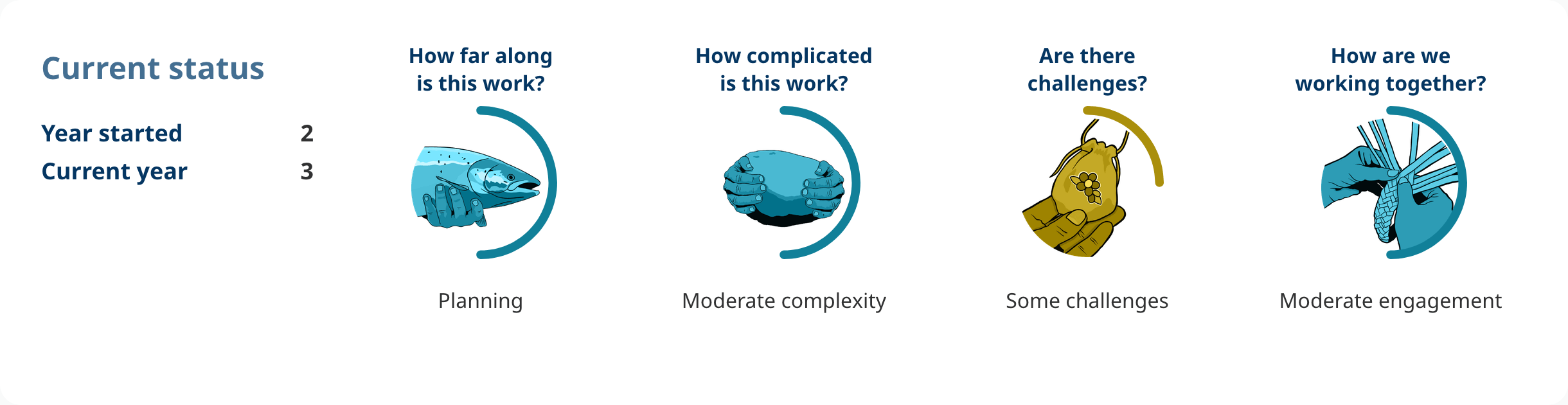
How are we working together?
The Ministry of Jobs and Economic Growth (JEG) has been working closely with the Regional Economic Trusts— the Economic Trust of the Southern Interior (ETSI-BC), the Island Coastal Economic Trust (ICET) and Northern Development Initiative Trust (NDIT)—to advance Action 4.39.In fall 2025, JEG established a working group that included First Nations representatives from each Trust region. This group has been co-developing policy options to support transitioning of the Trusts into a co-governed model. Additionally, as of March 2026, each Trust has achieved the following:
ETSI-BC: Completed consultations with First Nations in its service region, submitted an engagement report to the Province and continues to work with First Nations and other Indigenous-led organizations across the region to support access to funding intakes. ETSI-BC also keeps First Nations informed about the status of Action 4.39 through its quarterly eNews.
ICET: Sanala Planning, an Indigenous planning firm, completed consultations with First Nations in ICET’s service region and provided both the Province and ICET with an actionable First Nations strategic recommendations report related to Action 4.39.The report draws on in-depth, facilitated meetings with 33 First Nations, as well as outreach and engagement with 53 First Nations, supported by a detailed What We Learned report.
NDIT: Completed consultations with First Nations within its service region and submitted an engagement report to the Province. NDIT also engaged Candace Newman and Ashley Wright to develop an Indigenous implementation plan, which will offer thoughtful guidance by incorporating institutional insights and supporting the creation of inclusive mechanisms within the Trust’s work and decision-making processes.
Are there challenges?
JEG has received valuable feedback from First Nations partners, which has helped identify several considerations for moving forward. For example, ETSI-BC noted challenges related to timelines and complexity of policy options. ICET emphasized interest in additional Provincial allocation to the Trust. NDIT highlighted concerns regarding First Nations’ capacity to participate meaningfully in these projects, given multiple competing priorities. In addition, during the working group sessions with First Nations partners, JEG heard feedback regarding the timelines associated with this initiative.
Highlights
JEG continues to strengthen its relationships with Indigenous partners through ongoing collaboration and consensus-building, supported by feedback from the First Nations working group and other First Nations partner organizations. These insights have contributed to meaningful progress on Action 4.39.Additionally, as of March 2026, each of the Trusts has shared key highlights that reflect this momentum:
ETSI-BC reported notable steps toward advancing Indigenous inclusion in governance. The board chair—who is a member of the Simpcw First Nation—actively participates in the working group for Action 4.39.In preparation for future co-governance, ETSI-BC has also engaged an Indigenous consultant to support the Board in decolonizing its governance policies.
ICET emphasized the impact of its independent, Indigenous-led engagement process, which ensured that Indigenous self-determination guided the work in alignment with Article 4 of the UN Declaration on the Rights of Indigenous Peoples. This process produced community-driven recommendations from First Nations to both the Province and the Trust, marking a shift from traditional consultation toward a structural inclusion approach in shaping the Trust’s future. ICET also created regular opportunities for local government leaders and MLAs to hear directly from First Nations, fostering a multi-year regional dialogue that built strong consensus across Indigenous and non-Indigenous governments.
NDIT highlighted several collaborative achievements, including an increase in Indigenous-led applications to its funding programs. The Trust also finalized a Memorandum of Understanding with First Nations Health Authority and Northern Health Authority to support inter-city transportation, and it continues to work closely with Indigenous leaders on multiple transportation (rail and bus) and connectivity initiatives.
Previous years’ progress
Highlights
- The Economic Trust of the Southern Interior B.C led an inclusive, broad-based engagement with First Nations in their service region which has helped strengthen awareness and relationships between the Trust and First Nations in the region. First Nations leaders expressed support for a new governance model that brings them together with municipally and regionally elected officials to address regional economic development collaboratively.
- Island Coastal Economic Trust engaged 32 First Nations in its service region in 2024-25. Sanala held two-hour dialogue sessions and gathered many insights. These include how governance of the Trust can be transformed to drive long-term regional economic impact and harness local leaders’ diverse knowledge and relationships to build strategic and collaborative partnerships between their governments and businesses. First Nations leaders expressed support for the Trust being transformed into a model of co-governance and shared decision-making.
- Northern Development Initiative Trust worked with a team of consultants to engage with 66 First Nations in its service region in 2024-25. These consultants submitted a final report at the end of 2024. The results of the engagement were positive with First Nations leaders expressing support for a more inclusive governance model.
How are we working together?
The Ministry of Jobs, Economic Development and Innovation worked closely with three regional economic trusts — the Economic Trust of the Southern Interior B.C., Island Coastal Economic Trust, and Northern Development Initiative Trust — to develop and conduct a comprehensive series of engagements with all the First Nations located in their respective service regions.
- The Economic Trust of the Southern Interior B.C. worked with their Indigenous Outreach Consultant, Gail Joe, to engage a majority of the 33 First Nations in their service region. The engagement process started in July 2024 and finished in November 2024. Between November 2024 and February 2025, the trust held three in-depth meetings with First Nations leaders who expressed interest in providing input with the objective of exploring governance models and legislative amendments. Ministry staff are coordinating with the trust to receive their report.
- Island Coastal Economic Trust engaged Sanala Planning, who is conducting an independent Indigenous-led process with the majority of the 53 First Nations across Vancouver Island and the surrounding coast. They are exploring their vision for transforming the Trust to a new model of co-governance and shared decision-making. From these Indigenous-led engagements, First Nations and Sanala will produce a strategic recommendations report that will be provided to the trust, provincial government, Members of the Legislative Assembly, local governments and the public in Spring 2025.
- Northern Development Initiative Trust established an Indigenous Advisory Committee in 2022 to guide its work with First Nations. In 2024, the trust hired four independent consultants to engage with the majority of the 89 First Nations located in their service region to understand their views on representation in the Regional Advisory Committees and the Board of Directors. Each consultant submitted final reports at the end of 2024. Ministry staff are coordinating with the trust to receive their report.
Are there challenges?
The Province and trusts need to explore ways to address capacity constraints for engaging in direct dialogue with First Nations governments across each service region to ensure diverse perspectives and interests are incorporated into the design of a new mechanism for regional inclusion in decision-making.
Highlights
- Northern Development Initiative Trust has advanced planning and discussion of Action 4.39 through an Indigenous advisory committee. Northern Development Initiative Trust’s engagement team is currently being assembled with First Nations engagement expected to begin in Spring 2024. Northern Development Initiative Trust formed an Indigenous advisory committee to advance this work and has met six times since late 2022.
- Island Coastal Economic Trust is working with an independent Indigenous consultant from K’ómoks First Nation to develop an engagement and project plan with a goal to create a pathway for transformation of the trust in alignment with Action 4.39 and with Island Coastal Economic Trust’s strategic goal of co-governance. Island Coastal Economic Trust is working with an independent First Nations consultant on a project plan for engagement expected to occur throughout 2024/25 and has met with the Ministry of Jobs, Economic Development and Innovation (JEDI) and the consultant twice since early 2024.
- Economic Trust of the Southern Interior has initiated early engagement and planning with the intent to work with an Indigenous partner or advisor to further develop a region-specific engagement plan. Economic Trust of the Southern Interior has initiated early planning to explore potential First Nation partners with engagement expected to occur throughout 2024/25.
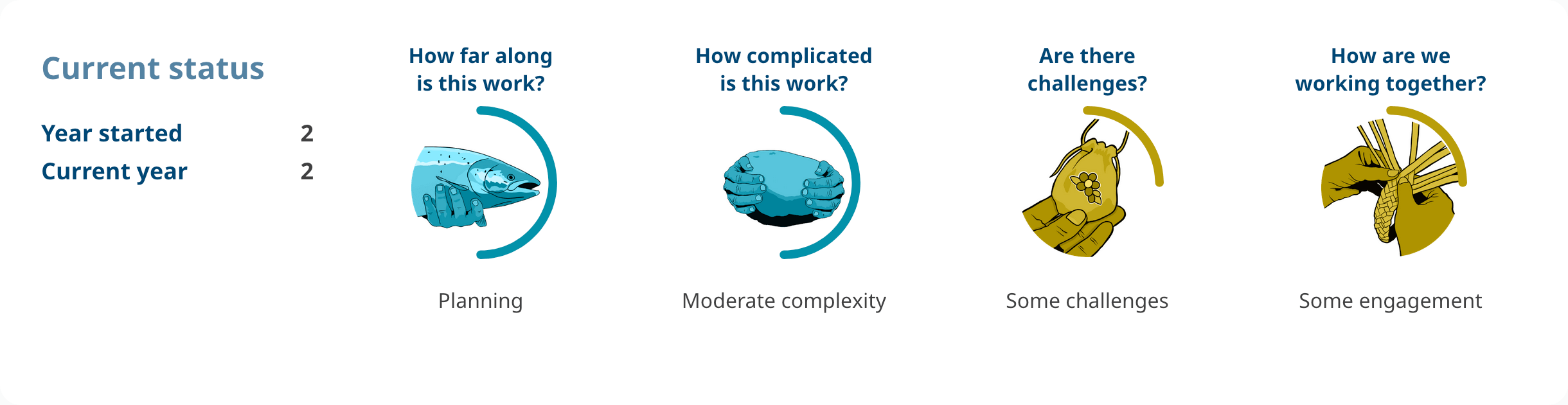
How are we working together?
The Province and the Trusts are planning an inclusive, broad-based engagement with First Nations in each service region throughout 2024/25 with the understanding that this will strengthen relationships between the Trusts and First Nations, raise awareness about the role of the Trusts, and allow for an open dialogue with First Nations on how they wish to be included in the governance of the Trusts going forward. Each Trust is working with an Indigenous partner or advisor to develop a region-specific engagement plan that reflects the diverse interests, priorities, and governance structures of First Nations in their respective service regions. The purpose of the engagement process is to seek input on mechanisms to ensure the inclusion of First Nations in regional decision-making, which may require changes to the enabling legislation and related regulations for each Trust.
The Province and the Trusts have established a working group and have convened to advance an approach for engagement with First Nations on potential changes to provincial legislation as to establish a mechanism that enables the inclusion and representation of First Nations in the governance of the Trusts.
Northern Development Initiative Trust established an Indigenous advisory committee in late 2022 for the purposes of strengthening relationships with the 89 First Nation communities in its service region, including engagement on a mechanism to ensure the inclusion of First Nations in the governance of the trust going forward.
Are there challenges?
The Province and the Trusts will need to explore ways to address capacity constraints for engaging in direct dialogue with First Nation Governments across each service region as to ensure a diversity of perspectives and interests are incorporated into the design of a new mechanism for regional decision-making.
Engage First Nation partners at a provincial and regional level to design inclusive engagement processes that allow for an open exchange of interests and ideas with First Nations across each service region, including opportunities to leverage capacity funding for communities available through the Declaration Act Engagement Fund, as well as the flexibility to support these processes through funding recently provided by the Province to each Trust.