
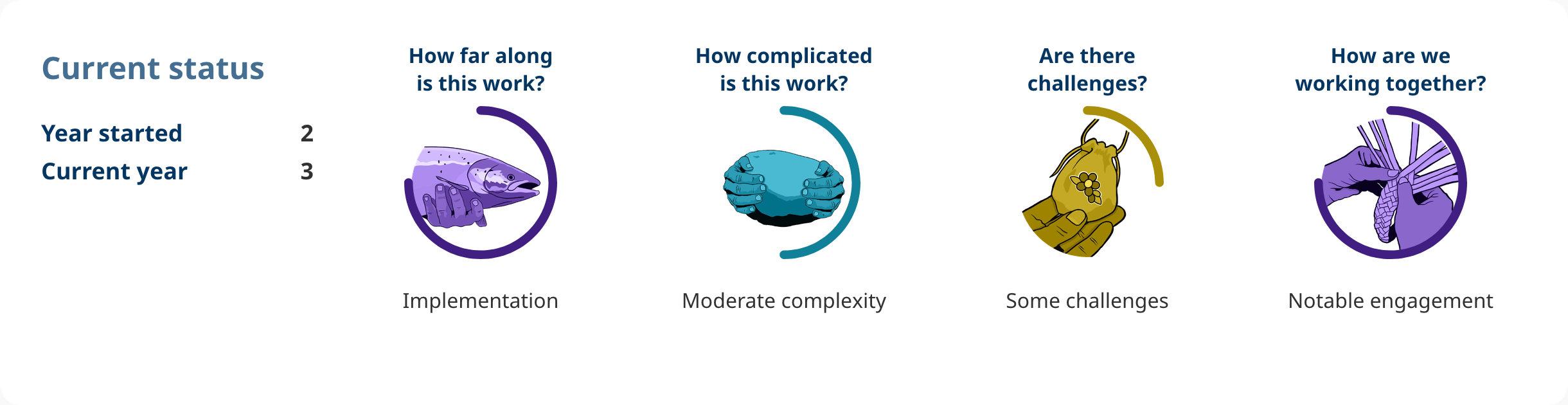
How are we working together?
Guided by section 4.16 of the Declaration Act Action Plan, the Ministry of Children and Family Development (the ministry) is co-developing a provincial funding model to support First Nations’ jurisdiction over child and family services with First Nations (partners) and in consultation with Indigenous organizations. Co-development activities include virtual meetings, in-person workshops and written input to the ministry.
The co-development approach is grounded in guidance from participating partners. This includes acknowledging the specific rights, interests, priorities and concerns of rights holders and Indigenous partners, and respects distinct and unique cultures, histories, rights, laws and governments.
At the beginning of 2025, the ministry focused on increasing participation in co-development through facilitated virtual sessions. This approach resulted in an increase of 32 additional First Nations participating for an overall total of 72 First Nations.
In spring 2025, the ministry facilitated 25 virtual co-development sessions covering 13 core funding model topics identified through earlier co-development activities in 2023-24. In May 2025, the ministry hosted an in-person workshop with co-development partners and Indigenous organizations. One hundred and two attendees representing 46 First Nations and Indigenous organizations attended. Throughout 2025, the ministry also received written input from some First Nations partners.
These co-development activities supported important progress on complex policy topics related to development of the provincial funding model. This work will continue in 2026.
Are there challenges?
The co-development of a funding model for First Nations’ jurisdiction over child and family services is a complex, multi-party process involving representatives from many First Nations across British Columbia, each with distinct priorities, governance contexts, and perspectives. As with other large-scale co-development initiatives, balancing inclusivity, meaningful engagement and timely progress has presented challenges. Perspectives on the pace of the work have varied, reflecting differing expectations and levels of readiness across participants.
Given the scope and significance of this work, partners have highlighted the importance of clarity around implementation sequencing and transparency in costing to support shared understanding. As the first province undertaking the co-development of a provincial funding model to support jurisdiction, both the ministry and partners are navigating new policy and fiscal terrain, which has required careful consideration and ongoing learning.
At the intergovernmental level, the federal government is currently operating under an interim funding approach. Timelines for the development and implementation of a long-term federal funding model have not yet been confirmed. Aligning a provincial funding model with a future federal approach will require continued collaboration amongst all parties.
Participation in co-development has also been influenced by broader capacity considerations, as many First Nations are advancing multiple priority initiatives simultaneously. All First Nations in British Columbia have been invited to participate in engagement opportunities, and the ministry continues to recognize the importance of creating space for participation as First Nations determine their own levels of involvement.
Highlights
The ministry continues to work with First Nations to finalize the jurisdiction funding model, recognizing partners’ need for greater detail and transparency to support this progress.
Previous years’ progress
Highlights
The ministry is working with First Nations and other Indigenous partners who expressed interest in engagement, as well as with Indigenous Services Canada, to facilitate the co-development of a provincial funding model to support First Nations in providing child and family services in B.C. In addition to virtual sessions, in-person workshops were held in April and August 2024.
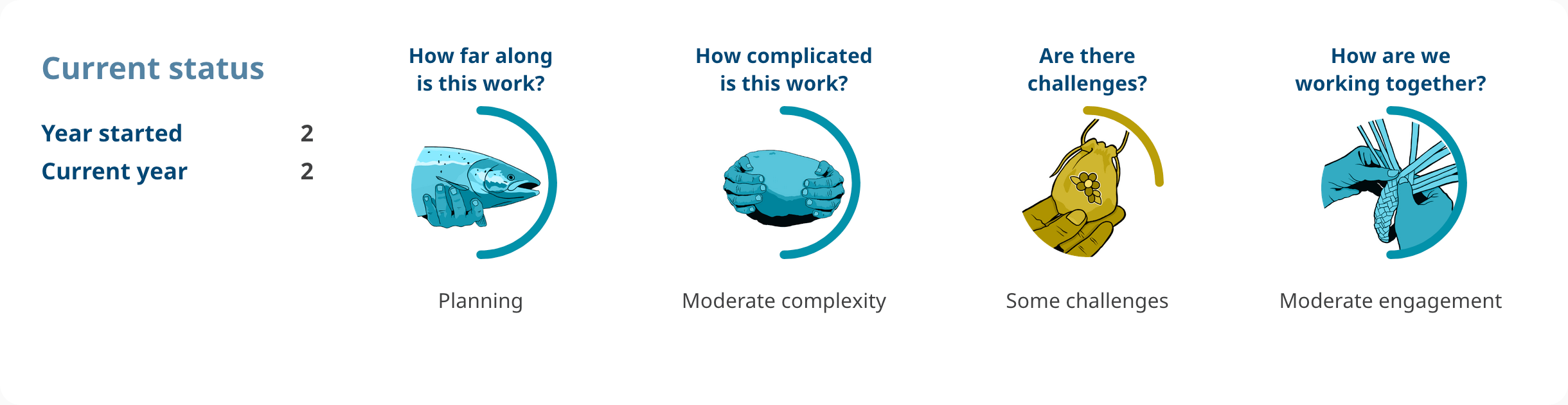
How are we working together?
The Ministry of Children and Family Development is working with First Nations and Indigenous partners who have expressed interest in engagement, as well as with Indigenous Services Canada, to facilitate the co-development of a provincial funding model to support First Nations providing child and family services in B.C. The ministry will continue to communicate with First Nations involved in the co-development process through written updates, invitations to engage in co-development sessions and in-person workshops.
Feedback received through the development process was shared in an interim what we heard report and will continue to be used to inform the development of a provincial funding model.
The ministry will continue to use an engagement and co-development approach that:
- Acknowledges the specific rights, interests, priorities and concerns of rights holders and Indigenous partners;
- Respects distinct and unique cultures, histories, rights, laws and governments; and
- Includes different approaches or actions that are responsive to distinct interests and perspectives.
Are there challenges?
Properly consulting with all First Nations in B.C., Modern Treaty Nations and First Nation groups in a reasonable timeframe to meaningfully advance co-development of the funding model will add significant complexity to the process of meeting the diverse needs and expectations of all parties.
The federal government is currently using an interim funding approach. The timeline for when the long-term federal funding model will be developed and implemented is unknown. Integration with a future federal funding model is a process that will require careful negotiations with all parties. Until integration is possible, provincial funding is subject to federal interim policies, including potential reductions in federal funding amounts where it is considered to overlap with areas where the Province contributes funding.
All First Nations in B.C., the First Nations Leadership Council, and Our Children Our Way Secretariat have been invited to review materials and join engagement sessions. Frequent written updates have been sent to partners. Due to capacity limitations, many partners have been unable to fully engage in the process. At the beginning of the funding model process, all First Nations in B.C, Métis and Inuit were invited to review materials and join engagement sessions.
Highlights
The Ministry of Children and Family Development (MCFD) was successful in launching the funding model co-development process in September 2023, with the release of a discussion paper and introductory engagement sessions. The paper and introductory engagement sessions were generally received positively. However, partners were critical of the initial April 2024 timeline as being too rushed and inconsistent with a meaningful co-development process. Partners also requested more detail than what was provided in the discussion paper. MCFD reflected on the feedback and presented partners with a revised timeline with an early 2025 implementation date and a more detailed co-development process based on MCFD’s experience in co-developing Bill 38, Indigenous Self-Government in Child and Family Services Amendment Act in 2022 with First Nations, Métis and Inuit. These changes were communicated in early 2024 and were generally well received by partners. Detailed co-development sessions launched in March 2024 and will continue.
During the reporting year, 49 sessions were held to support a wide range of Nations in understanding, advancing and contributing to the process of co-development for a provincial funding model to support First Nations jurisdiction over child and family services.
A draft discussion paper, Building a Funding Model to Support First Nations Jurisdiction over Child and Family Services in B.C., was released in September 2023, with feedback from the First Nations Leadership Council (FNLC) and Indigenous Services Canada. The interim What We Heard report recapping feedback received in fall 2023 engagement sessions is in development.
How are we working together?
MCFD is consulting with the partners who expressed interest in engagement, as well as with Canada, in co-development sessions to facilitate the co-development of a provincial funding model to support First Nations jurisdiction over child and family services in B.C. MCFD will continue to send communications to First Nations providing written updates and invitations to engage in bi-weekly co-development sessions, monthly update sessions and in-person workshops. The first in-person workshop was held in Vancouver on April 25, 2024. Feedback received will be documented and shared in a What We Heard report and will be used to inform the development of a provincial funding model.
Are there challenges?
All 204 First Nations, FNLC, MNBC and Inuit groups have been invited to review the September 2023 discussion paper, provide feedback and participate in engagement sessions designed to co-develop a new funding model for children and family services in B.C. However, not all have been engaged. Frequent written updates have been sent to funding model co-development partners as the process continues. Multiple invitations to engage were sent to all First Nations in B.C. and FNLC via letter, MCFD’s Indigenous child and family services newsletter and through a govTogether website. MNBC and some First Nations have indicated challenges with capacity to engage and currently only First Nations can access engagement funding through the Declaration Act Engagement Fund.
In February 2024, MCFD invited all First Nations to participate in bi-weekly co-development planning sessions. In keeping with a distinctions-based approach, MNBC was invited to meet monthly to provide feedback on the Building a Funding Model to Support First Nations Jurisdiction over Child and Family Services in B.C. report.