
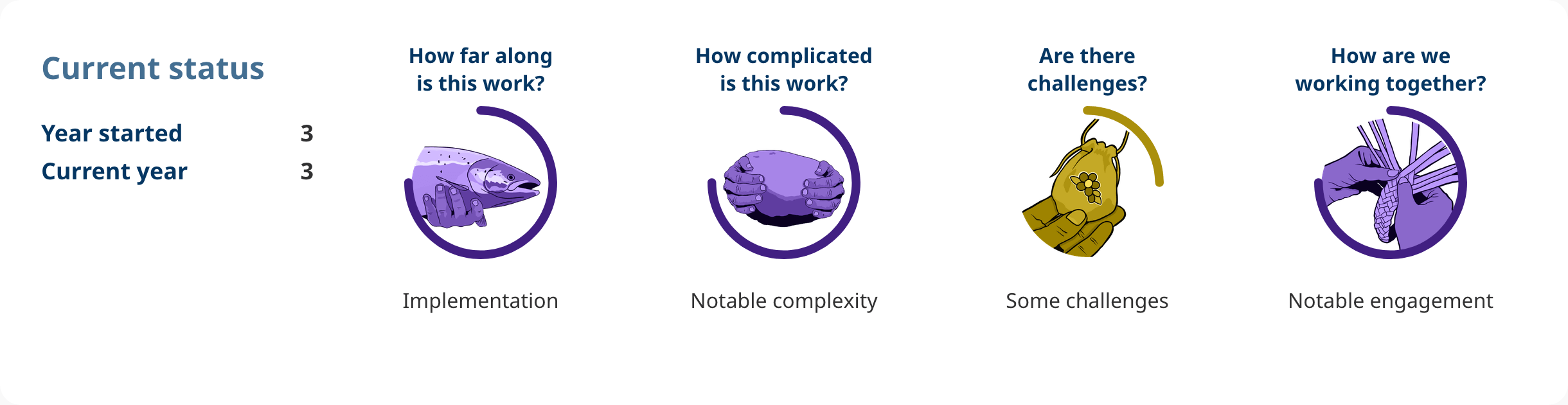
How are we working together?
The Ministry of Tourism, Arts, Culture and Sport (TACS) advances action 3.05 through the BC Arts Council (BCAC) by providing funding to Indigenous artists, organizations and collectives. Support for Indigenous-led arts and cultural initiatives strengthens public understanding of Indigenous histories, rights, cultures and the impacts of Indigenous-specific racism throughout B.C. The work is guided by a distinctions-based approach that recognizes the unique rights, priorities and governance structures of First Nations, Inuit and Métis Peoples.
A key and long-standing partnership supporting this action is with the First Peoples’ Cultural Council (FPCC), a First Nations–led Crown corporation. Through annual funding of $1.725 million, BCAC supports FPCC-delivered programs that promote artistic and cultural expression and strengthen the vitality of First Nations arts in B.C. These programs provide employment opportunities, advance intergenerational knowledge transfer and expand opportunities for public learning about First Nations histories and cultural revitalization. In 2025/26, BCAC and FPCC collaborated to strengthen outreach initiatives and improve information sharing. FPCC provides policy insight and strategic advice through regular leadership-level engagement.
BCAC prioritizes Indigenous representation in governance: 25 percent of council members identify as Indigenous. Guidance from the BCAC Elder-in-Residence, Roy Henry Vickers, and Joint Indigenous Arts Advisory Circle further supports the development of an Indigenous arts strategy and policies related to governance and engagement. Together, these practices help ensure Indigenous perspectives are meaningfully integrated into council decisions and priorities in support of Action 3.05.
Are there challenges?
TACS continues to advance Action 3.05 in a challenging operating environment. Economic uncertainty, along with constrained capacity and limited resources within the ministry, partners, organizations and communities have affected the pace and scope of implementation.
Meaningful engagement with Indigenous partners remains central to this work. However, provincial government-wide budget and travel restrictions during 2025/26 limited opportunities for in-person meetings. In addition, the impacts of province-wide staff job action earlier in the fiscal year created temporary disruptions to timelines. As a result, engagement and outreach activities shifted to virtual formats where possible. While these approaches supported continued dialogue, they did not fully replace the relationship-building and collaboration that occurs through in-person engagement.
Demand for funding from Indigenous organizations and artists, including B.C. First Nations, outpaces available resources. Despite these challenges, progress continued throughout the year with creative solutions for collaboration and resourcing being sought to continue to meet community demand for Indigenous arts and culture revitalization in B.C.
Highlights
Progress was made toward advancing Action 3.05 through the continued development of an Indigenous arts strategy for the BCAC. This work is guided by the Joint Indigenous Arts Advisory Circle (JIAAC), which includes Indigenous members of the BC Arts Council and Indigenous arts and culture community members. JIAAC has provided policy insight and program advice to inform the strategy’s development. The Indigenous arts strategy will be a key component of BCAC’s next strategic vision and implementation plan, aligning with the Anti-Racism Data Act, Anti–Racism Act, the Declaration Act Action Plan and strengthening support for Indigenous-led arts and cultural initiatives.
Initial implementation steps have included increased funding support for Indigenous artists and arts organizations through existing BCAC grant programs and targeted strategic investments. These actions are helping expand opportunities for Indigenous artists and organizations to share their work with the public and contribute to greater understanding of Indigenous cultures, histories and perspectives.
During the reporting period, BCAC strengthened connections with national organizations and networks focused on Indigenous arts and culture. These engagements support knowledge exchange across jurisdictions and create opportunities to discuss emerging priorities in arts funding and approaches that enhance public understanding of Indigenous cultural expression.
The BCAC Secretariat has been engaged in exploratory discussions with the Ministry of
Indigenous Relations and Reconciliation on intersections between Action 3.05 and Action 4.21, including opportunities to support the priorities of urban Indigenous Peoples through potential collaboration with BC Urban Indigenous Coalitions.
Previous years’ progress
Highlights
Renowned artist, carver, storyteller, author, and community leader of Tsimshian, Haida, and Heiltsuk heritage, Roy Henry Vickers is the BC Arts Council inaugural Elder-in-Residence, a role which recognizes the importance of Indigenous knowledge, perspectives, and self-determination.
In alignment with Action 3.05, the BC Arts Council provides funding to the Elder-in-Residence to provide guidance for continued work to integrate equity and reconciliation across the arts sector and provide greater support for the Indigenous organizations. He also provides mentorship and knowledge-sharing for young Indigenous artists, playing a vital role in supporting and strengthening the transmission of Indigenous arts, culture and histories.
The BC Arts Council has formally initiated work on an Indigenous Arts Strategy to support Indigenous organizations and applicants through its programs, supported by an Indigenous Arts Advisory Group consisting of Indigenous Council and community members. This work is ongoing.
How are we working together?
The Ministry of Tourism, Arts, Culture and Sport is continuing existing relationships and actively considering other potential partnerships with Indigenous organizations to fulfill this action. Consultation and co-operation approaches will differ for each Indigenous organizational partner in accordance with a distinctions-based approach.
The ministry has heard from local Indigenous artists, community members, and Indigenous-led organizations and First Nations through engagement events and participation in roundtable discussions. Feedback from these sessions is being incorporated into the strategic vision for the BC Arts Council.
Additionally, the ministry continues to meet with Métis Nation BC as part of the Province’s alignment with a distinctions-based approach.
Indigenous arts and culture practitioners contribute to the BC Arts Council Equity Advisory Network. Members of First Nations and other Indigenous individuals make up over 25% of the Arts Council’s membership. Roy Henry Vickers has been the Arts Council inaugural Elder-in-Residence since March 2024, providing guidance on this new role.
The BC Arts Council has a long-standing partnership with First Peoples’ Cultural Council (FPCC), a First Nations-led Crown corporation, provides $1.725 million annually to support the FPCC’s arts programs, which supports valuable jobs for First Nations artists. The BC Arts Council has worked with the FPCC on outreach and engagement initiatives, while the FPCC has provided input on BC Arts Council policies, with regular meetings between leadership teams to build relationships and work together.
The BC Arts Council has established a Joint Indigenous Arts Advisory group made up of Indigenous BC Arts Council members and community members to guide the development of the BC Arts Council’s Indigenous Arts Strategy. This work will focus on developing an approach to better support Indigenous artists and organizations in B.C. through policy, programs and outreach.
Are there challenges?
Reaching out and connecting with other Indigenous organizations to partner with on Action 3.05 is measured to ensure meaningful engagement between the B.C. government and Indigenous organizations across the province. This work faces challenges in these uncertain economic environments. While consistent progress is being made, creative solutions for collaboration and resourcing are being sought to continue to meet community demand for Indigenous arts, culture and language revitalization in B.C.