
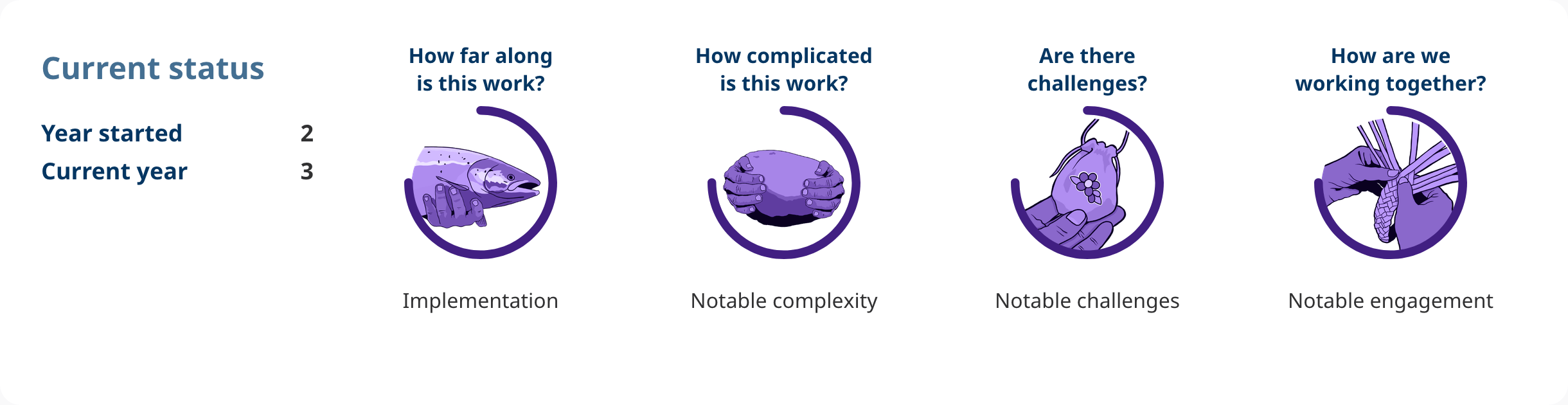
How are we working together?
The Ministry of Mining and Critical Minerals (MCM) is advancing Mineral Tenure Act (MTA) reform in consultation and co-operation with First Nations, consistent with the Declaration on the Rights of Indigenous Peoples Act and a distinctions-based approach.
During the 2025/2026 reporting period, engagement focused on targeted bilateral discussions with First Nations to inform policy development and identify priority areas for legislative reform. These discussions supported relationship-building and early input into potential approaches. In parallel, the ministry advanced preparatory work to support broader consultation and co-operation, including collaboration with the First Nations Leadership Council to reconstitute a working group and develop a refreshed terms of reference. This work will support a more structured and transparent engagement process. Engagement has been informed by implementation of the Mineral Claims Consultation Framework (MCCF), with input from ongoing consultation activities helping to inform policy development of potential changes to the MTA. The ministry has also maintained communication with the mineral exploration and mining sector and other interested parties to support transparency. The planning, timing and scope of broader engagement have been influenced by available staff and resources and the need to coordinate work within a complex and evolving legal and policy context.
Are there challenges?
The work is being advanced within a complex and evolving legal and policy context. In 2023, the ministry was ordered by the BC Supreme Court to consult on mineral claim registrations, which has required the ministry to prioritize implementation of the MCCF, while also continuing to make progress on broader legislative reform.
Further, constraints related to available staff and resourcing and the volume of concurrent engagement on initiatives across the natural resource sector have influenced the planning and timing of broader consultation and co-operation.
This has resulted in periods of intermittent progress with work on MTA reform advancing slower than ordinally planned. To mitigate these challenges, the ministry has taken a phased approach, focusing on targeted bilateral discussions during this reporting period.
The ministry continues to adapt its approach to support meaningful consultation and co-operation while managing these pressures.
Highlights
The ministry has implemented the court-ordered MCCF to support consultation with First Nations on mineral claim registration. The previous online staking system offered no opportunity for consultation and provided automatic claim registration. The new system provides for applications that are then consulted upon with a target timeline of 90 to 120 days for decisions.
During the reporting period, the ministry conducted internal work to advance MTA reform through continued policy development and targeted bilateral engagement with First Nations. These discussions helped identify priority areas for reform and inform potential policy approaches for legislative change. The ministry recognizes the importance of consultation and co-operation to further inform and influence policy approaches.
Progress was also made to establish foundational engagement structures, including collaboration with the First Nations Leadership Council to reconstitute a working group and supporting terms of reference. This work strengthens the foundation for future consultation and co-operation.
Previous years’ progress
Highlights
The ministry is committed to working in consultation and co-operation with First Nations and First Nations Organizations to align the MTA with the UN Declaration, as required by section 3 of the Declaration Act.
The Mineral Tenure Act Modernization Office commenced early policy exploration with First Nations, and First Nation Organizations with the release of a discussion guide in August 2024. Consultation and Cooperation through established consultation and cooperation pathways will continue in 2025.
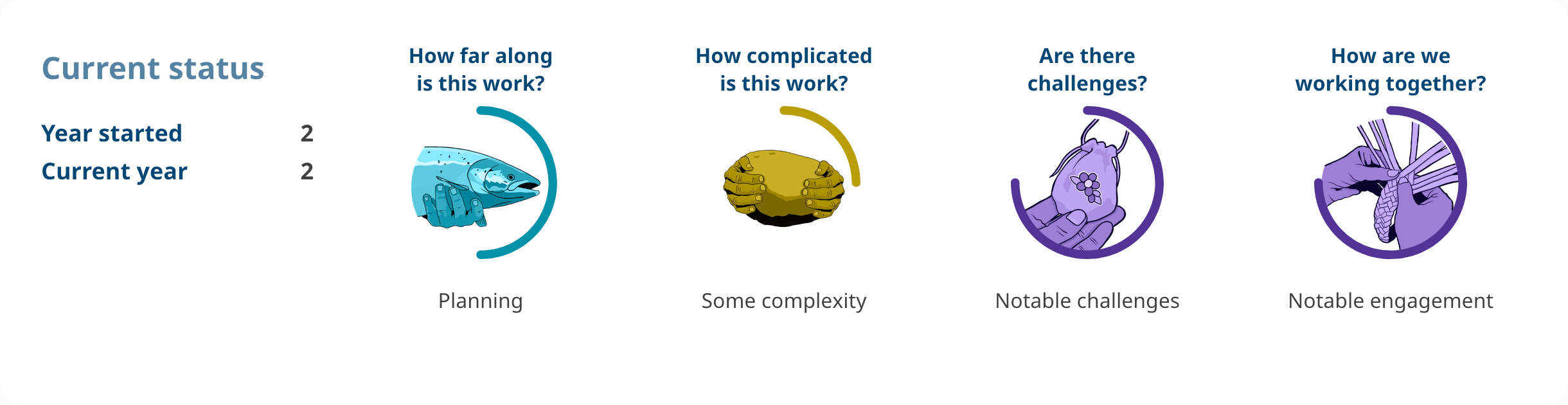
How are we working together?
A consultation and co-operation framework has been developed with consideration of feedback from a sample of First Nations, the First Nations Leadership Council (FNLC) technical working group, as well as the Declaration Act Secretariat (the Secretariat). The consultation and co-operation framework is intended to be evergreen and is expected to evolve as needed.
Pathways for an open and transparent consultation and co-operation process began in Summer 2024 and will recommence in 2025.
These pathways include:
- All-Nation sessions with all First Nations rights and title holders
- Bi-lateral engagement with First Nations rights and title holders
- A technical advisory group with First Nations representatives
- Technical working group with participants from FNLC, the First Nations Energy and Mining Council, the Declaration Act Secretariat and the Ministry of Attorney General
As this work continues, the Province is committed to making sure First Nations and First Nations organizations are provided ample opportunity to partner in the development of a new mineral exploration legislative framework. This will include opportunities to directly contribute to the drafting of all key milestone documents outlined in the Interim Approach for the Implementation of Section 3 of the Declaration on the Rights of Indigenous Peoples Act.
Are there challenges?
The Ministry of Mining and Critical Minerals recognizes the need for dedicated and ongoing engagement opportunities for industry and the public, in addition to the consultation and co-operation framework established for rights holders. Aligning the Mineral Tenure Act (MTA) with the United Nations Declaration on the Rights of Indigenous Peoples (UN Declaration) as required by section 3 of the Declaration on the Rights of Indigenous Peoples Act (Declaration Act) will be a significant transformation for the mineral exploration sector in B.C. amid global investment uncertainty, which heightens industry and public attention on economic development and investment certainty supported by known regulatory frameworks. As a result, ongoing, focused engagement is essential to build a shared understanding of the goals of MTA reform.
Developing a new mineral exploration legislative framework will require considering diverse perspectives in a collaborative way, including differentiating between First Nation rights holders and existing regulatory stakeholders. The Province must enhance public understanding of the UN Declaration principles and reconciliation to foster meaningful collaboration.
In Spring 2024, the ministry prioritized the design and implementation of a new mineral claims consultation framework to respond to the B.C. Supreme Court ruling in Gitxaala vs. British Columbia (Chief Gold Commissioner). This is a separate but concurrent initiative alongside MTA reform. This division of efforts limited the ministry’s capacity to conduct consultation and co-operation on MTA reform in a way that meets First Nations’ expectations. Since Summer 2024, the ministry has focused its consultations with First Nations on the court ruling, with consultation and co-operation on MTA reform set to resume in 2025.
Highlights
The Ministry of Energy, Mines and Low Carbon Innovation (EMLI) is committed to working in consultation and co-operation with First Nations and First Nations organizations to modernize the Mineral Tenure Act (MTA). In July 2023, a dedicated MTA Modernization Office was established along with a working group with the First Nations Leadership Council (FNLC) technical team and First Nations Energy and Mining Council (FNEMC). The working group has focused on co-development of foundational documents for the reform. Engagement with First Nations was initiated in September 2023, and a First Nations Technical Advisory Group was established to support this work in March 2024.
How are we working together?
The Ministry has established tables for government-to-government conversations with nations, a First Nations technical advisory group to provide policy recommendations related to mineral exploration, and a working table with FNLC and the BC First Nations Energy and Mining Council (FNEMC) on the alignment of a new statute with the UN Declaration.
Are there challenges?
While the work to establish a dedicated MTA modernization office was underway, a decision by the B.C. Supreme Court (BCSC) (Gitxaala vs. British Columbia (Chief Gold Commissioner)) in September 2023, found that the Province has a constitutional duty to consult First Nations on mineral claims. The decision was suspended for 18 months to allow time for the Province to design and implement a consultation process for claim staking.
EMLI is required to undertake the work directed by the BCSC, while simultaneously taking on the broader and transformational work of MTA reform. Differentiating the near-term consultation and co-operation work to develop a consultation standard for claim staking from the broader alignment of the statute with the UN Declaration is complex.
Pre-engagement information sessions in March 2024 identified the degree of broad public interest in the reform, specifically a desire to see focused conversations with various interested groups. EMLI has been responsive to this interest through establishing dedicated engagement opportunities for industry and providing publicly available information on the reform.